
By John Spera
1 July 2026
Hard physical training does far more than improve the body. It changes the brain itself. For years, fitness was primarily viewed through a physical lens: stronger muscles, better endurance, lower body fat, improved cardiovascular health. While those benefits absolutely matter, modern neuroscience has made something increasingly clear: difficult physical training also has a profound effect on mental health, emotional regulation, stress tolerance, and psychological resilience.
Research discussed in The Exercise Effect on Mental Health: Neurobiological Mechanisms explains that intense exercise stimulates the release of brain-derived neurotrophic factor, or BDNF, often referred to as “fertilizer for the brain.” BDNF supports neuroplasticity, learning, emotional regulation, and the brain’s ability to adapt to stress. In simple terms, hard training helps physically reshape the brain in ways that improve resilience and mental performance.
Exercise also influences neurotransmitters such as dopamine, serotonin, and norepinephrine, chemicals heavily tied to mood, motivation, focus, and stress management. Over time, difficult physical training does not simply create a fitter body. It creates a nervous system that becomes more capable of handling adversity. That matters tremendously in professions built around stress exposure, uncertainty, discomfort, and high consequences.
In the fire service, law enforcement, military, emergency medicine, and other high-pressure professions, people are routinely placed into environments that overload the nervous system. Elevated heart rates. Heat stress. Sleep deprivation. Heavy breathing. Confusion. Adrenaline. Fatigue. Psychological pressure. Physical exhaustion. Yet many people still treat fitness as if it were only about appearance or passing a yearly test. In reality, hard training may be one of the most practical and accessible forms of mental resilience training we have helping contribute to mental health.
The reason is simple: the brain adapts to what it repeatedly experiences. When a person consistently avoids discomfort, the nervous system becomes less tolerant of stress. When someone repeatedly escapes hard situations, the brain learns avoidance. But when someone voluntarily confronts physical difficulty over and over again, the nervous system gradually learns something different: this is uncomfortable, but survivable.
That adaptation matters. Hard workouts force a person to repeatedly experience elevated heart rate, heavy breathing, muscular fatigue, discomfort, frustration, and psychological resistance while continuing to function anyway. The body is under stress, but the individual learns to maintain composure and continue operating inside that stress. The individual learns to endure difficulty well.
This is one reason exercise has repeatedly been shown to reduce symptoms of anxiety and depression significantly. A large meta-analysis published in the Journal of Psychiatric Research found that exercise significantly reduced depressive symptoms across multiple populations and training styles. More recently, a 2024 umbrella review published in The BMJ analyzing hundreds of randomized controlled trials concluded that exercise is highly effective at reducing depression symptoms across a wide variety of populations and exercise modalities.
The evidence continues pointing in the same direction: movement is not only medicine for the body, but one of the most powerful tools we have for strengthening the mind.
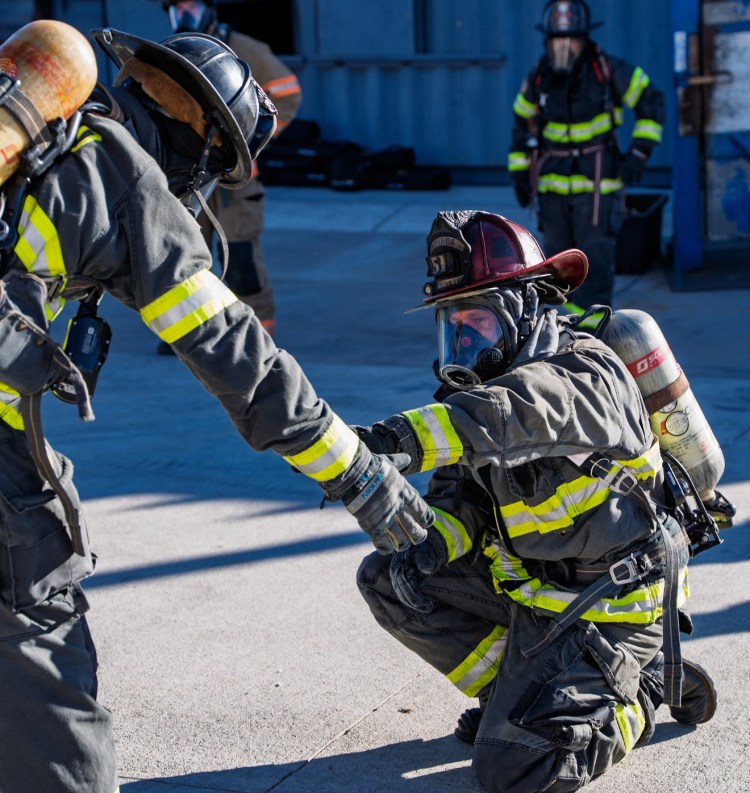
This becomes especially visible during difficult forms of training. Consider the firefighter completing a brutal gear workout in full turnout gear and SCBA. The environment is hot, restrictive, claustrophobic, and physically exhausting. Air feels limited. Vision is impaired. Heart rate skyrockets. The body begs and at times screams to stop, yet they continue moving. Or the endurance athlete deep into an ultramarathon after hours of accumulated fatigue. Legs cramping. Feet blistered. Mind bargaining for comfort. Every step becomes a psychological negotiation. Or the person attending an intense training course designed to push them mentally and physically far beyond comfort. Demanding work volume. Long hours. Sleep deprivation. Repetition. Stress. Uncertainty. Self-doubt.
These experiences are difficult physically, but they are also neurological and psychological training exposures. Every time a person continues functioning under controlled adversity, they are teaching the nervous system that stress does not automatically require retreat. That lesson transfers. It transfers into leadership. It transfers into difficult conversations. It transfers into relationship. It transfers into emergency situations. It transfers into moments where composure matters more than emotion.
This is one reason many people who train hard regularly often describe exercise as one of the anchors of their mental health. Difficult training creates structure, discipline, routine, momentum, and evidence-based confidence. Not motivational confidence. Earned confidence. There is a major difference. Motivational confidence is often emotional and temporary. You read a quote, you listen to a podcast, or you sit through a lecture leaving motivated but really haven’t done anything to earn confidence. Earned confidence is built through repeated evidence collected over time. Rep by rep. Step by step. The experience builds a bank of proof, that you are someone who can endure hard things.

You begin trusting yourself because you have repeatedly proved to yourself that you can function while uncomfortable. You have trained to manage your emotions. You proved you can keep going while tired. You proved you can stay composed while under pressure. You proved you can continue performing when the situation becomes difficult.
That process changes people psychologically. There is also something profoundly important about voluntary discomfort itself. Modern life has become increasingly engineered around convenience, comfort, and immediate relief. Climate control. Instant entertainment. Constant stimulation. Endless distraction. Food delivery. Social validation. Comfort on demand. Yet the human nervous system was not designed to grow stronger through perpetual comfort. Growth often requires stress exposure.
Hard physical training provides exactly that. A difficult workout becomes controlled adversity. The discomfort is voluntary, but the adaptation is real. That is why many people leave hard workouts feeling mentally clearer, calmer, and more emotionally stable despite physical exhaustion. The workout acted as a stress exposure session that helped regulate the nervous system rather than overwhelm it.
For firefighters specifically, difficult physical training may be even more important because the job itself places such enormous demands on the nervous system. Firefighters routinely encounter high heat environments, low visibility, exhaustion, chaos, emotional trauma, sleep disruption, and life-threatening conditions. The body’s stress response activates rapidly and repeatedly throughout a career. Fitness alone will not eliminate psychological stress, but it can increase resilience to it.
When firefighters regularly train in gear, perform challenging work capacity sessions, push through hard conditioning workouts, complete long endurance events, or expose themselves to controlled physical hardship, they are not simply improving fitness metrics. They are developing greater tolerance for stress exposure itself. A firefighter who has repeatedly learned to stay composed while breathing hard, overheating, and exhausted during training is more likely to maintain composure when the stakes are real. Preparation turns chaos into clarity.
This does not mean training should become reckless or purely punishing. The goal is not suffering for the sake of suffering. Controlled stress only creates positive adaptation when paired with recovery, intelligent programming, and sustainability. But avoiding difficulty entirely creates fragility. The nervous system becomes less adaptable when it is never challenged.
This is why hard training often creates benefits far outside physical performance. People who train consistently often report improved emotional regulation, better stress tolerance, increased discipline, improved confidence, better sleep, and greater resilience during adversity. They improved their mental health.
The training itself becomes rehearsal for life. You learn that feelings fluctuate, but standards remain. You learn that the mind often quits before the body truly needs to. You learn that discomfort is temporary. You learn that difficult moments can be endured. You learn that calmness can be practiced. You learn that resilience is trainable.
Over time, these lessons compound. The individual who repeatedly chooses difficult physical work gradually develops a different relationship with discomfort itself. Stress no longer feels as threatening because the nervous system has repeatedly practiced functioning inside it. That may be one of the most overlooked mental health tools available today. Not because exercise magically removes hardship, anxiety, grief, trauma, or depression, but because difficult physical training builds a stronger, more adaptable human being capable of carrying those burdens more effectively.
The science increasingly supports what many people have intuitively known for years: hard physical training changes the mind. It strengthens emotional tolerance. It improves stress resilience. It builds earned confidence. It teaches composure under pressure. It improves mental health. And in a world increasingly built around comfort and avoidance, difficult training may be one of the few remaining places where people voluntarily practice becoming mentally tougher, emotionally steadier, and more capable of enduring adversity.
Movement is not just physical preparation. It is a neurological preparation. Psychological preparation. And in many ways, preparation for life itself.
Photos courtesy of John Spera.


Intense exercise also raises cortisol, which is a normal training response. For some people, lower-intensity activities like walking or Zone 2 running may provide many of the mental health benefits with less overall stress load.
LikeLike