By Bill Carey
26 July 2026
When the Associated Press reported that Yelp announced that it was integrating artificial intelligence into its platform to summarize hundreds of customer reviews into concise recommendations, the reaction was largely positive. Instead of spending thirty minutes reading dozens of reviews about a restaurant, users could receive a synthesized summary in seconds.
At first glance, the technology appears to solve a common problem: having more information available than time to consume it.
Beneath this convenience lies a broader question that extends far beyond restaurant recommendations.
What happens when people stop reading the evidence and begin relying exclusively on someone – or something else – to interpret it for them?
For most consumers, the consequences of choosing the wrong restaurant are relatively minor. For firefighters, however, outsourcing understanding has the potential to influence training, risk perception and ultimately operational decision-making.
The Shift from Reading to Receiving
Years ago, obtaining knowledge required reading books, manuals, technical reports or scientific journals. The internet shortened that process by making information searchable. Social media shortened it further by reducing complex topics into short posts, infographics and videos.
Artificial intelligence took the next step.
Rather than directing users to original sources, AI increasingly delivers the conclusion itself.
The user receives an answer without engaging in the process of evaluating how that answer was reached.
This distinction is significant because reading comprehension is not simply the ability to recognize written words. Cognitive psychologists describe comprehension as an active process in which readers construct meaning by integrating new information with existing knowledge, evaluating evidence, recognizing contradictions and drawing conclusions. These cognitive processes are fundamental to critical thinking.
When individuals consistently consume synthesized information rather than original material, they practice these skills less frequently.
Convenience Comes at a Cognitive Cost
Artificial intelligence is exceptionally effective at reducing cognitive effort. It removes redundancy, highlights key themes, and condenses hundreds of pages of information into a few concise paragraphs. While these capabilities improve efficiency and accessibility, they also reduce the cognitive engagement that underpins meaningful learning.
Educational researchers have long distinguished between recognition – the ability to identify or recall information -and understanding – the ability to explain, evaluate and apply that information in new contexts. Because AI-generated summaries are typically coherent, fluent, and easy to process, they can create the impression that a reader has mastered a subject.
Psychologists refer to this phenomenon as the illusion of explanatory depth, in which individuals overestimate their understanding of complex topics simply because the explanation appears complete and intuitive. Genuine understanding, however, does not develop through passive exposure to information alone. It emerges through active engagement, as readers evaluate evidence, reconcile conflicting ideas, and wrestle with the complexity and nuance contained in the original material.
The Fire Service Already Operates This Way
Although artificial intelligence is a relatively recent development, the fire service has been engaging in a similar form of cognitive outsourcing for years.
Rather than reading complete line-of-duty death investigation reports, many firefighters encounter incidents through social media posts, YouTube videos, podcasts, conference presentations or commentary from influential fire service personalities. While these sources can provide valuable educational insights, they also serve a role similar to AI-generated summaries by interpreting the information before the audience has the opportunity to examine the original evidence. As a result, a forty-page investigation may be distilled into a sixty-second video, a complex sequence of tactical decisions reduced to a single takeaway, or an incident involving multiple contributing factors summarized as one memorable lesson.
Although these condensed narratives are easier to consume, they inevitably omit context, nuance, and supporting evidence. Consequently, many firefighters may be learning about an investigation through someone else’s interpretation rather than learning from the investigation itself by critically evaluating the original report.
The Difference Between Data and Interpretation
Every LODD investigation consists of two distinct components: objective evidence and subjective interpretation. The objective evidence includes measurable facts such as incident timelines, building construction, fire behavior, staffing levels, communications, environmental conditions, and tactical decisions.
Interpretation, by contrast, seeks to explain what those facts mean and what lessons should be drawn from them. Artificial intelligence excels at generating these interpretations, as do social media personalities, conference presenters, and authors—including this one. While such analyses can provide valuable educational context, they are not substitutes for the underlying evidence itself.
When firefighters rely primarily on summarized interpretations rather than examining original investigation reports, they become increasingly dependent on another person’s analytical process.
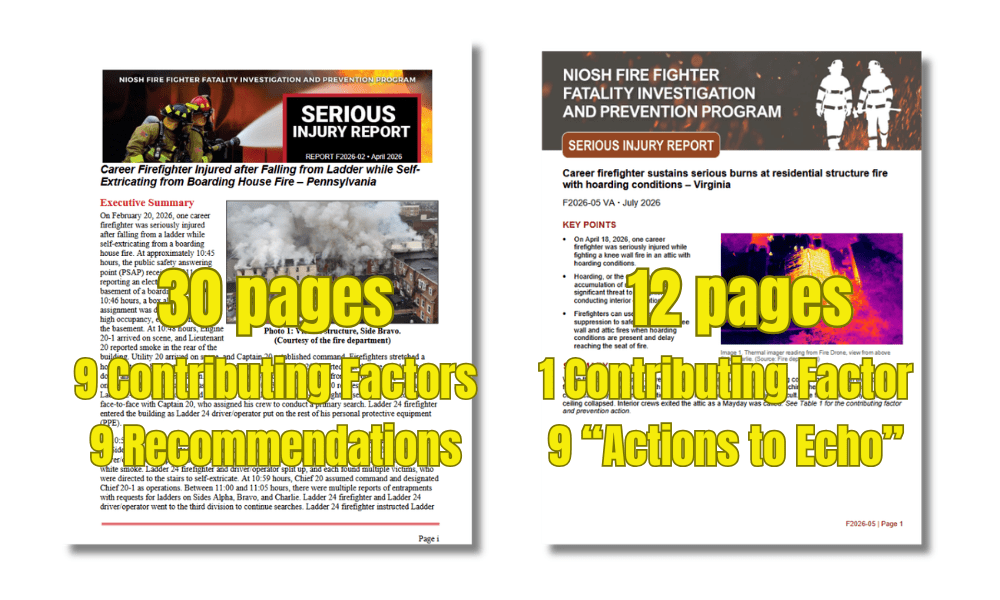
Over time, this reliance may diminish their ability to independently evaluate evidence, recognize nuance, challenge conclusions, and develop the critical thinking skills necessary for sound operational decision-making.
The Parallel to Risk Perception
This issue is particularly relevant to how firefighters perceive operational risk. Research in cognitive psychology has consistently shown that individuals estimate risk not only through statistical evidence but also through memorable stories, emotionally charged events, and repeated exposure to similar information.
Social media platforms amplify dramatic incidents because emotionally engaging content generates greater attention and interaction, while artificial intelligence increasingly summarizes the discussions surrounding those incidents into concise narratives.
Together, these technologies create a learning environment in which emotionally significant events receive disproportionate cognitive attention, while statistically representative events receive comparatively little.
For example, a firefighter who repeatedly encounters summaries of interior line-of-duty deaths, structural collapses, or maydays may begin to perceive these incidents as more common than they actually are. Without examining complete investigation reports, annual line-of-duty death statistics, or long-term historical trends, firefighters may inadvertently substitute frequency of exposure for frequency of occurrence. This phenomenon reflects the cognitive bias known as the availability heuristic, whereby events that are more vivid, emotionally salient, or easily recalled are perceived as occurring more frequently than they do in reality.
Consequently, repeated exposure to summarized, emotionally charged incidents can shape firefighters’ perceptions of risk in ways that may not accurately reflect the underlying evidence.
Preserving Critical Thinking
Artificial intelligence will almost certainly become a permanent component of firefighter education. The challenge, therefore, is not to resist its adoption but to integrate it in ways that enhance rather than replace critical thinking.
AI should serve as the beginning of inquiry, not its conclusion. A well-crafted summary should encourage firefighters to consult the original investigation report, while a synthesized explanation should stimulate questions rather than substitute for independent analysis.
To preserve analytical skills and evidence-based decision-making, instructors should continue to emphasize primary sources, complete line-of-duty death investigations, and comprehensive datasets alongside AI-assisted learning tools. Used in this manner, artificial intelligence can improve access to information without diminishing the critical evaluation and deep engagement necessary for sound operational judgment.
The Yelp story represents more than the evolution of online reviews. It reflects a broader shift from reading original information to relying on summarized interpretations. The fire service is experiencing a similar transition as social media and artificial intelligence increasingly condense complex line-of-duty death investigations and operational research into easily consumed narratives.
While these tools offer convenience and improve access to information, they should not replace direct engagement with the original evidence.
Preserving independent judgment and evidence-based decision-making requires firefighters to move beyond summaries and continue reading investigation reports, research studies, and complete datasets for themselves.
Next: Which Is Better at Reading: AI or a Firefighter?
Featured image courtesy of Yelp/Facebook.

