By Bill Carey
13 September 2026
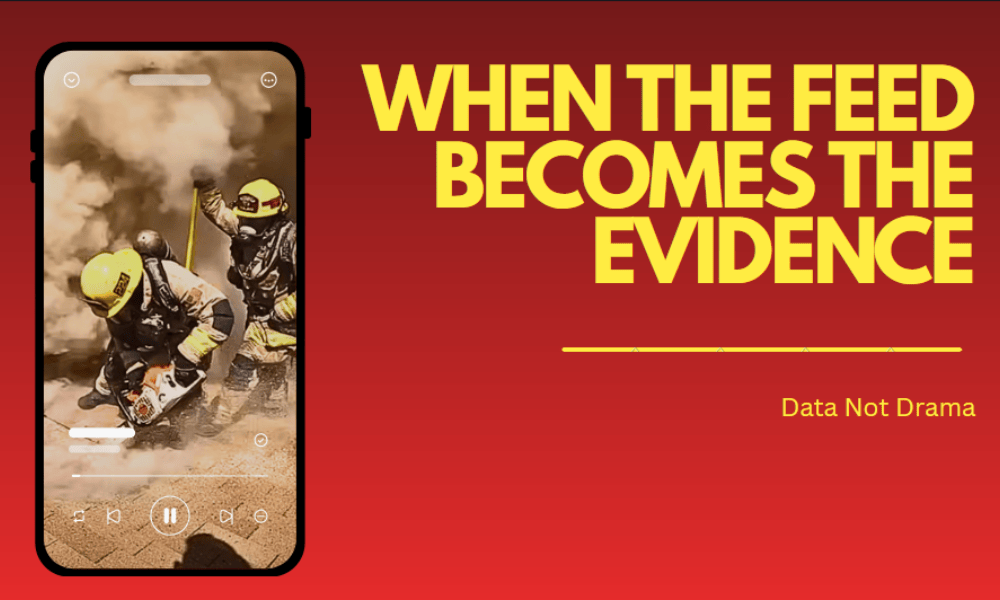
For the fire service, social media is a useful tool to share lessons learned. Unfortunately, its use can also distort information, leading some firefighters to overestimate risk and others to underestimate it.
Research in psychology, risk communication, and behavioral science shows that metrics, algorithms and feeds support the view that social media affects a firefighter’s perception, understanding and explanation of risk [1, 2].
Risk information is processed through psychological, social, institutional and cultural processes that can increase or reduce risk perceptions.
The availability heuristic: If I keep seeing it, it must be common
A heuristic is a quick mental shortcut in reasoning. We use them every day. Some examples are:
- A packed restaurant parking lot means the food is good.
- A quiet person wearing glasses is considered an introvert, a nerd.
- News of a plane crash heightens a fear of flying.
- News of a shark attack leads to fear of swimming at the beach.

Psychologists Daniel Kahneman and Amos Tversky described the availability heuristic as a shortcut in which you judge something by how quickly it comes to mind. It is a fast process based on vivid visuals and does not involve rational thinking or fact-checking. Fear of flying and shark attacks are common examples.
The availability heuristic is very common among firefighters online because social media has a constant stream of:
- Line-of-duty death anniversary posts
- Helmet camera videos
- Mayday recordings
- Fireground close calls
Their repeated exposure makes them cognitively available (how quickly information comes to mind when you need to make a decision). As a result, firefighters may begin believing these incidents occur far more frequently than they actually do.
The perceived frequency of an event becomes disconnected from its actual frequency. Repeated exposure can make the event feel common.
Perceived frequency is not the same as actual frequency
Consider a firefighter who encounters multiple posts during a single week describing interior firefighters becoming trapped. Those posts may involve incidents occurring across several years and thousands of fire departments. Yet the social media feed presents them sequentially, without the geographic, temporal, or denominator information necessary to understand their actual frequency.
The brain does not naturally process that information as a statistical database.
Instead, it remembers the examples which can be a cognitive shortcut:
“I’ve seen this repeatedly and others agree, so it must be serious.”
That conclusion may be understandable, but it may also be statistically incorrect.
The same can occur with LODDs on social media. A firefighter might encounter several anniversary posts involving firefighters who died during interior operations. This emotional repetition can create the impression that interior structural firefighting accounts for a large proportion of firefighter deaths. Yet an examination of the specific fireground LODD data can produce a substantially different picture, particularly when traumatic interior deaths are separated from the much larger category of on-duty deaths that includes medical and other non-traumatic events.
Social media can therefore compress time and geography.
An incident from California, an incident from New York, and an incident from a department thousands of miles away may appear consecutively in the same feed. The brain experiences these events as a sequence rather than as independent events separated by distance, years and exposure opportunities.
This creates a digital clustering effect or bias. This leads you to perceive patterns in random data and predictability in life where none exists.
Social media platforms group users and content based on patterns in behavior, interests, engagement and interactions. In marketing, algorithms can identify what a consumer engages with and then deliver more content that fits those patterns or clusters [3].
Engage with a type of content → receive more similar content → repeatedly encounter the same themes or products → perceive them as more popular, relevant, or important.
For firefighters it looks like this,
Engage with LODD content → receive more LODD content → repeatedly see similar incidents → perceive those incidents as more common or significant.
As a result, a firefighter’s social media feed can become a concentrated representation of particular risks, tactics, or opinions. A firefighter who frequently watches mayday videos, comments on firefighter fatalities, or engages with posts about structural collapse may consequently encounter far more of that material than other firefighters.
The events are not necessarily occurring together in reality but they are occurring together in the firefighter’s information environment.
In this sense, digital clustering does not necessarily create false information; it can create a distorted sample of real information.
Over time, digital clustering can reinforce the availability heuristic. The more frequently a particular type of incident appears in the feed, the easier it becomes to recall, and the more common that risk may seem.
The availability heuristic can cause people to judge how common or likely something is based on how easily examples come to mind. Repeated exposure to LODDs, maydays, near misses, dramatic rescues, and fireground videos can shape this perception. Because these events are highly visible and emotionally memorable, firefighters may perceive them as more frequent or likely than they actually are.
Repeated exposure can make a rare event feel common, disconnecting perceived risk from actual risk.
Become a better reader by understanding the availability heuristic
Watch for posts or comments with dramatic stories, fear-triggering words, and shocking numbers. See past what is easily remembered and change how you interact with the text using these strategies:
- Ask for specifics: When someone highlights a dramatic problem, ask, “How often does this actually happen?” Look for the actual probability or total percentage, not just the isolated incident.
- Separate drama from truth: Remind yourself that ease of recall does not equal frequency or truth. Just because you can easily picture a scenario doesn’t mean it is a widespread reality.
- Remember the boring data: Pay extra attention to all of the LODD numbers. Because the majority lack emotional punch, your brain will naturally want to skip or forget them, even though they carry the real factual weight.
References
- Kasperson, R. E., Renn, O., Slovic, P., Brown, H. S., Emel, J., Goble, R., Kasperson, J. X., & Ratick, S. (1988). The social amplification of risk: A conceptual framework. Risk Analysis, 8(2), 177–187.
- Kasperson, R. E., Webler, T., Ram, B., & Sutton, J. (2022). The social amplification of risk framework: New perspectives. Risk Analysis, 42(7), 1367–1380.
- Jagatia, E. (2025, March 12). K-means clustering in social media management: A statistical approach. Medium.
 Data Not Drama