Why precision matters when talking about firefighter gear, PFAS,
exposure and cancer risk
By John Spera
The ongoing debate over whether firefighters should be working out and training in clean gear due to cancer concerns has grown louder, and that is exactly why it is important to examine the main study these claims are based on closely. Too many people are speaking in absolutes, acting as if the science has already proven that wearing turnout gear during workouts and training causes cancer.
That is not a responsible way to handle an issue this important. Before people throw around conclusions, they need to read what the study actually says, understand the specific conditions it used, and pay attention to the limits the authors themselves put on their findings. The study at the center of this debate is NIST Technical Note 2260, Per- and Polyfluoroalkyl Substances in Firefighter Turnout Gear Textiles Exposed to Abrasion, Elevated Temperature, Laundering, or Weathering.
The conversation around PFAS in firefighter turnout gear has become increasingly heated, and in many cases, increasingly careless. Some people dismiss the issue entirely. Others claim this study proves that wearing firefighter gear is causing cancer. Neither response is responsible. The only honest way to talk about this paper is to read what the researchers did, what they measured, and what they explicitly said their study could and could not prove. NIST states that this report measured 51 PFAS in 20 firefighter turnout gear textiles after exposure to abrasion, elevated temperature, laundering, or weathering.
Before getting into the gear study itself, it helps to define what PFAS are. The U.S. Environmental Protection Agency describes PFAS as widely used, long-lasting chemicals whose components break down very slowly, which is why they are often called “forever chemicals.” EPA also notes that, because of their widespread use and persistence, many PFAS are found in the blood of people and animals worldwide and are present in water, air, fish, and soil.
The Agency for Toxic Substances and Disease Registry says PFAS have been used in consumer and industrial products since the 1940s and that people can be exposed through contaminated drinking water, food, dust, soil, food packaging, fish, or wild game from contaminated areas, and products such as water-repellent clothing and stain-resistant materials. So, when people talk about PFAS, they should understand they are referring to a broader exposure issue, not a problem limited to the fire service.
That broader context matters because firefighter gear does not exist in a vacuum. The real scientific question is not just whether PFAS are present. The question is how much exposure comes from a specific source, through what route, under what conditions, and with what health significance. EPA’s discussion of PFAS risk reflects the same principle: health risk depends on the specific PFAS involved, the level and duration of exposure, and the route of exposure.
The NIST turnout-gear report was not a cancer-outcomes study. It did not follow firefighters over time, compare cancer incidence between firefighters with different gear histories, or measure firefighters’ blood PFAS levels before and after normal gear wear. NIST’s stated purpose was narrower: this second report was intended to determine whether stressing turnout textiles could help explain why older or used turnout gear has sometimes shown higher PFAS concentrations than new gear.
That distinction is critical. A textile chemistry study is not the same thing as a disease-causation study. This paper focused on what happened to measured targeted PFAS concentrations in turnout textiles after stressing, not on proving that normal use of turnout gear causes cancer in firefighters. That does not make the study unimportant. It simply means it must be discussed honestly and within the limits the authors themselves put on it.
To study that question, NIST exposed the textiles to four categories of stress: abrasion, elevated temperature, laundering, and weathering. The abrasion testing used a Martindale abrasion tester under 9.0 kPa ± 0.2 kPa pressure, with each specimen undergoing 20,000 rubs at 47.5 revolutions per minute. The elevated-temperature protocol used a hot-air circulating convection oven at 260 to 268 °C (500 to 514.4 °F), preheated for at least 30 minutes, with the samples left in the chamber for five minutes after the measured temperature returned to 260 °C (500 °F). The weathering protocol used an accelerated QUV chamber with repeated UV, water spray, and condensation cycles over 300 total hours.
Those details are not minor. They are central. The heat test did not involve casually warming gear or ordinary station use. It involved a severe lab protocol at 260–268 °C (500–514.4 °F). The weathering test was not the same thing as routine outdoor exposure. It involved 300 hours of accelerated UV and moisture cycling under controlled chamber conditions. That does not make the study invalid. It just means the study was testing what happens under specific laboratory stress procedures, not proving that normal wear produces the same effects in the same way.
The results showed that PFAS levels in the textiles changed after stressing, but not in a simple, one-directional way. NIST reported that, compared with corresponding unstressed textiles, individual and summed PFAS concentrations in all textile types were higher following abrasion but were similar to or lower following laundering. NIST also reported that summed PFAS concentrations were higher in outer-shell textiles following exposure to elevated temperatures and weathering.
That is a meaningful finding. It supports the conclusion that stressing turnout textiles can change the amount of measurable targeted PFAS in those materials. But this is also where people begin overstating the paper. The authors themselves directly warn against overreading the results. NIST states that although physical stressing may contribute to altered PFAS concentrations, the mechanisms responsible for these changes “cannot be authoritatively identified” by the targeted analytical approach used in the study.
That limitation matters a lot. NIST explains that its analytical method cannot distinguish between PFAS produced through degradation or transformation and PFAS that were already present in the textile or fluorinated polymer treatment and became easier to measure after the material was stressed. In other words, the study shows altered measured targeted PFAS concentrations in stressed textiles, but it does not fully resolve the mechanism behind those changes.
NIST also explicitly states another major limitation in the discussion. The authors note limitations that complicate correlating observed changes in PFAS concentrations with changes in the amount of PFAS a firefighter may be exposed to through firefighting gear. They also note that targeted PFAS measurements account for only a small fraction of the total fluorine present in firefighter gear textiles.
That means this paper did not directly measure firefighter dose from routine wear. It did not quantify how much PFAS a firefighter inhaled, absorbed through skin, or ingested while performing normal duties. It did not establish that ordinary daily wear reproduces the same conditions as a 260 °C (500 °F) oven test or 300 hours of accelerated chamber weathering. Those are important scientific gaps, and the authors acknowledge them themselves.
At the same time, the study should not be dismissed. It supports concerns that firefighter turnout gear can be part of the PFAS exposure picture. NIST reported that during abrasion, fragments were observed falling from the textiles, indicating that abrasion of firefighter gear could contribute to fire station dust. NIST also reported that some textiles lost up to 17% of their original mass during elevated-temperature exposure and stated that, if this mass loss reflects the release of gaseous PFAS, similar losses may occur during field use.
So, the honest conclusion is not that the paper means nothing. It means the paper supports concern, but not exaggeration. Firefighters already operate in a profession with a documented cancer burden. NIOSH reported that, in its large cohort of nearly 30,000 career firefighters, researchers found a 9% increase in cancer diagnoses and a 14% increase in cancer-related deaths compared with expected rates in the U.S. population.
But our profession is exposed to a complex mix of hazards, including combustion products, soot, diesel exhaust, contaminated surfaces, and other toxic exposures in addition to gear-related concerns. PFAS themselves are also a legitimate health concern. EPA says scientific studies have shown that exposure to some PFAS may be linked to harmful health effects in humans and animals, while also emphasizing that there are thousands of PFAS and that risk varies by compound, dose, and exposure setting. ATSDR likewise says studies suggest exposure to some PFAS may be linked to harmful effects, while more research is still needed.
So, the bottom line is this: NIST Technical Note 2260 does not prove that ordinary day-to-day use of firefighter turnout gear causes cancer due to PFAS. What it does show is that turnout gear textiles containing PFAS can exhibit altered measured targeted PFAS concentrations after specific laboratory stress protocols, including abrasion, elevated temperature, laundering, and accelerated weathering. It supports concerns about gear as a potential exposure source. It supports continued scrutiny, further exposure research, and continued pressure for safer materials.
It is also worth noting that some departments have already adopted policies that prohibit firefighters from working out in gear, based on this study. That makes it even more important to speak accurately about what this paper does and does not prove. We also must seriously consider the repercussions of not consistently training in our gear due to this study. If firefighters become less prepared for the heat-trapping, range-of-motion restriction, weight, movement demands, and work capacity required in gear when it counts, that has consequences too. Not preparing in the gear will limit our ability to perform at a high level.
The study, by itself, does not establish the full chain from textile chemistry to real-world firefighter dose to cancer causation. So before repeating absolutes or making fear-based claims, educate yourself first. Read the study. Understand the conditions used. Understand its limits. Then make an educated decision about whether the benefits of physically preparing in gear outweigh the potential risks.
References
National Institute of Standards and Technology. Per- and Polyfluoroalkyl Substances in Firefighter Turnout Gear Textiles Exposed to Abrasion, Elevated Temperature, Laundering, or Weathering (Technical Note 2260). (govinfo.gov)
U.S. Environmental Protection Agency. PFAS Explained. (epa.gov)
U.S. Environmental Protection Agency. Our Current Understanding of the Human Health and Environmental Risks of PFAS. (epa.gov)
Agency for Toxic Substances and Disease Registry. PFAS and Your Health. (atsdr.cdc.gov)
National Institute for Occupational Safety and Health. Firefighter Cancer Rates: The Facts from NIOSH Research. (cdc.gov)
John Spera is a Denver Metro area firefighter with 23 years in the fire service and the founder of Fit To Fight Fire. He is a leading advocate for firefighter fitness and believes that mental and physical fitness are the foundation of a prepared firefighter. Through his work, he is committed to helping firefighters build functional fitness, a high work capacity, and the resilience required to perform at the highest level. fittofightfireusa.com
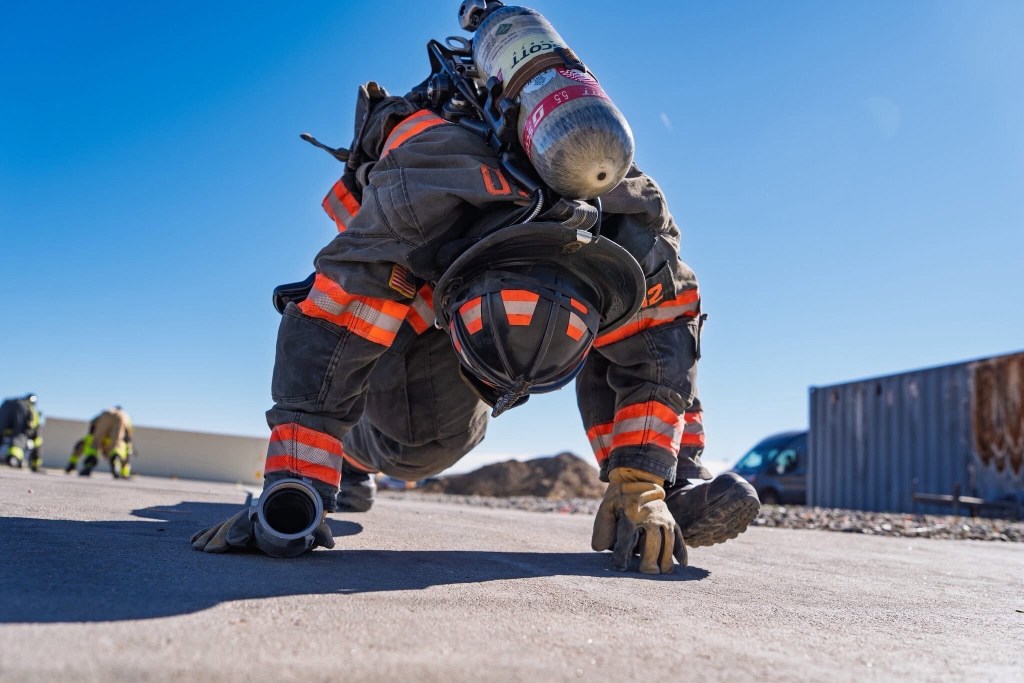
Photograph courtesy of John Spera.


Leave a Reply