Two viral Facebook posts about medals and “trauma celebrities” exposed a deeper tension inside the modern fire service: the growing conflict between authenticity and performance in an attention-driven culture
By Bill Carey
10 May 2026
Two recent Facebook posts struck a nerve across the fire service. On the surface, they addressed very different issues: awards culture and mental health culture. But beneath the surface, both posts pointed to the same deeper concern — the growing tension between authenticity and performance in modern fire service culture.
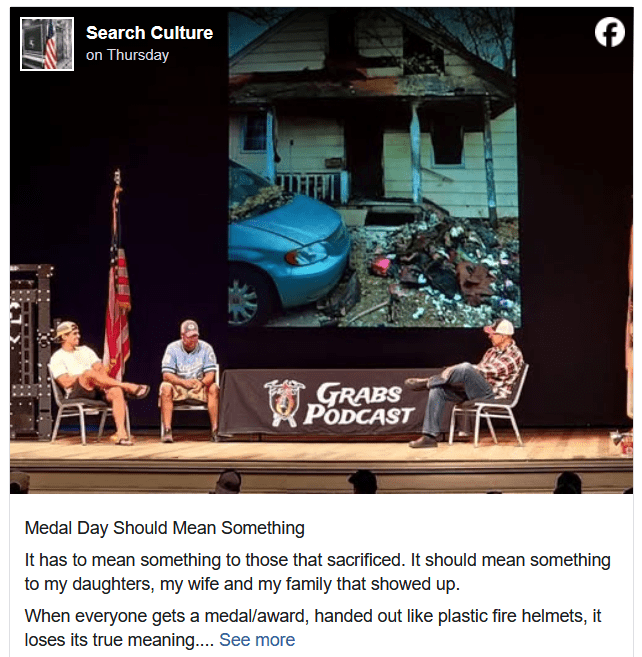
One criticized what the author viewed as the over-distribution of medals and ceremonial recognition:
“When everyone gets a medal/award, handed out like plastic fire helmets, it loses its true meaning.”
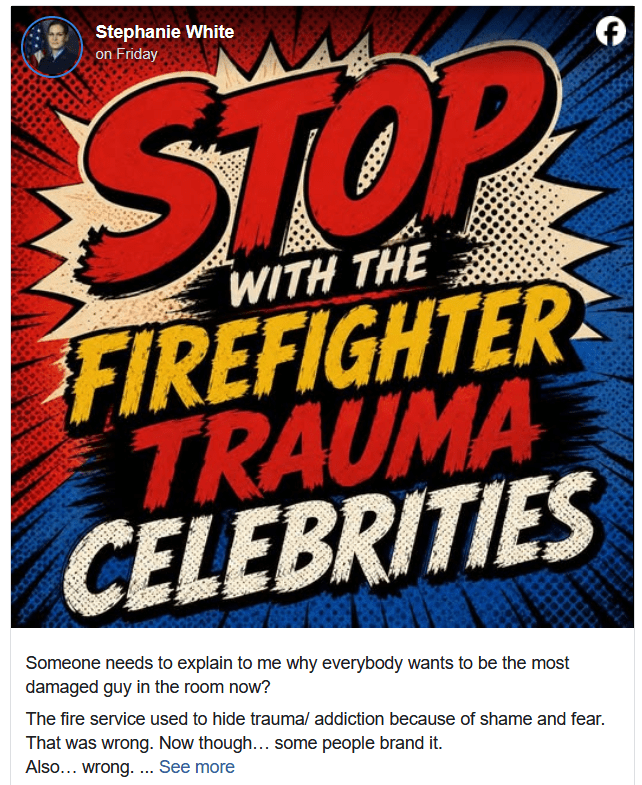
The other criticized the rise of what it called “firefighter trauma celebrities”:
“A culture got created where pain is getting applause, suffering gets followers, and whoever tells the darkest story suddenly becomes the voice of the movement.”
In my opinion, these posts are not really about medals or therapy. They are about symbolism, status, marketing and identity. More specifically, they reflect genuine concern about how social media has altered what the fire service rewards, amplifies and celebrates.
This conversation closely parallels themes explored in the article “The ‘Taylor Swift Effect’ and Fire Service Personalities on Social Media”, which examined how social media personalities increasingly shape firefighter culture, training, identity and decision-making through influence-driven online engagement.
“The challenge for the profession is to ensure the loudest voices online are not just popular but credible, responsible, and committed to firefighter safety. If rookies are going to scroll for training as often as they study a manual, the fire service must guide them on how to filter, question and verify what they see.”
Bill Carey, “The ‘Taylor Swift Effect’ and Fire Service Personalities on Social Media”
Recognition as Identity
The first post argues that formal recognition has become inflated. In the author’s view, medals that were once reserved for extraordinary sacrifice are increasingly distributed for routine contributions, administrative achievements or generalized service. The concern is not opposition to appreciation itself. The concern is dilution.
In organizational culture, symbols matter because they communicate values. Medals, commendations, challenge coins, ribbons and ceremonies are not merely decorative. They are signals that tell members what the institution considers honorable.
Historically, many fire service awards centered on visible acts of risk and sacrifice: rescues, line-of-duty injuries, and extraordinary courage under extreme conditions. When awards expand to encompass broader categories of contribution, some members interpret that change as a shift in institutional priorities.
The post reflects a belief that recognition should remain scarce because scarcity preserves meaning. In this framework, over-recognition becomes performative rather than reverential.
But there is another dimension underneath the argument: visibility.
Modern departments increasingly operate in a public-facing environment driven by recruitment challenges, retention concerns, political oversight, and social media optics. Recognition ceremonies are no longer solely internal rituals. They are branding tools. Departments market culture externally through carefully curated images of appreciation, professionalism, and morale.
That changes incentives.
Awards become not only mechanisms of gratitude, but instruments of organizational image management.
The Rise of the Trauma Narrative
The second post identifies a parallel phenomenon in the mental health space. The author argues that some individuals have transformed trauma into personal branding, where emotional exposure becomes social capital.
Again, the post is not attacking mental health treatment itself. In fact, it explicitly acknowledges that the old culture of silence and shame was harmful:
“The fire service used to hide trauma/addiction because of shame and fear. That was wrong.”
The criticism instead targets what the author sees as a newer distortion: the monetization and performance of suffering.
The fire service has undergone a major cultural shift over the past two decades regarding behavioral health. PTSD, suicide, depression, addiction, and cumulative stress are discussed more openly than ever before. That openness has unquestionably helped many firefighters seek support who otherwise might have suffered in silence.
But social media changes how those conversations function.
Platforms reward emotional intensity. Algorithms amplify outrage, vulnerability, conflict, and personal disclosure because those forms of content generate engagement. In that environment, trauma can become not only a lived experience but a public identity.
The “Taylor Swift Effect” article described how modern fire service personalities build direct relationships with audiences through storytelling, emotional connection, livestreams, podcasts and culture-driven messaging. The same mechanics that build loyalty around tactical personalities can also elevate emotionally charged mental health narratives.
The post suggests that some figures gain authority not through expertise, recovery, or long-term stability, but through increasingly dramatic storytelling. The “darkest story” becomes a credential.
This creates a difficult tension. Authentic vulnerability can genuinely help others. But social media also incentivizes repeated public exposure of pain because attention itself becomes reinforcing.
The author’s central argument is that healing is usually quiet, disciplined and unglamorous:
“Real healing? It’s usually boring and a lot of hard, quiet work.”
That observation clashes directly with the economics of online visibility, where quiet stability rarely becomes viral content.
The Common Thread: Performance vs. Substance
Both posts ultimately revolve around the same fear: that the fire service is increasingly rewarding appearance over substance.
In one case:
- Recognition risks becoming disconnected from extraordinary sacrifice.
In the other:
- Authority risks becoming disconnected from demonstrated recovery or wisdom.
Both critiques emerge from concern that symbolic value is being inflated, marketed, or commodified.
This concern mirrors one of the central warnings from the “Taylor Swift Effect” article: popularity and reach can easily become confused with credibility or expertise in the digital fire service environment.
This is not unique to the fire service. Nearly every profession influenced by social media experiences similar tensions. But the fire service is particularly vulnerable because identity and culture have always been central to the profession.
Firefighters do not merely perform a job. The occupation historically carries strong symbolic meaning associated with courage, sacrifice, resilience, and brotherhood. Social media accelerates the conversion of those symbols into personal brands.
Today, firefighters can accumulate status through:
- Tactical imagery
- Motivational content
- Podcast appearances
- Award visibility
- Emotional storytelling
- Conference speaking circuits
- “Influencer” identity
None of those things is inherently bad. Many people using these platforms genuinely educate, support and improve the profession.
The problem emerges when the incentives of visibility begin reshaping the culture itself.
Marketing Has Entered the Firehouse
The fire service increasingly exists in attention economics.
Departments market themselves.
Individuals market themselves.
Training companies market themselves.
Mental health advocates market themselves.
Leadership brands market themselves.
Social media rewards certainty, emotional intensity, and identity-driven messaging. Nuance performs poorly online. Quiet competence performs poorly online. Humility performs poorly online.
The “Taylor Swift Effect” article specifically noted that algorithms reward “bold statements and conflict,” often elevating rhetoric over nuance inside fire service discussions.
That environment naturally elevates extremes:
- The most decorated
- The most traumatized
- The most aggressive
- The most outraged
- The most emotionally exposed
As a result, firefighters may begin confusing visibility with credibility.
This dynamic is not isolated to the fire service. Modern celebrity culture, influencer culture, and online fandoms all demonstrate similar patterns of parasocial loyalty, identity-driven engagement, and emotionally amplified discourse. Online discussions surrounding celebrities like Taylor Swift frequently illustrate how digital audiences can blur the line between authenticity, branding, influence, and identity itself.
This does not mean recognition is wrong. It does not mean mental health advocacy is wrong. It does not mean storytelling is wrong.
It means the fire service must remain aware that modern communication platforms subtly reshape cultural incentives.
What These Posts Actually Reveal
The emotional reaction these posts generated likely reflects a broader unease inside the profession.
Many firefighters sense that portions of the culture are becoming increasingly performative:
- Heroism performed for branding
- Trauma performed for engagement
- Leadership performed for visibility.
- Recognition performed for optics
At the same time, many members also recognize that older cultures of silence, emotional suppression, and exclusion caused genuine harm.
The challenge is balancing authenticity without turning identity into marketing.
That balance is difficult because the fire service has always valued narrative. Stories are how firefighters teach, bond, memorialize, and preserve tradition. Social media simply industrialized storytelling into a constant public performance.
The result is a profession now struggling to distinguish between:
- awareness and exploitation,
- recognition and inflation,
- vulnerability and branding,
- leadership and self-promotion,
- advocacy and monetization.
These Facebook posts resonated because they touched a cultural nerve far larger than medals or mental health. They reflected concern about what the fire service increasingly rewards — and whether visibility itself is slowly becoming mistaken for value.
Photo courtesy of Nickleback/YouTube.


Leave a Reply