By Bill Carey
3 January 2026
You want to know what the point is?
Alright.
Let’s stop pretending this is a mystery.
The point is that we’ve spent years arguing about firefighter risk as if volume equals truth. As if the most emotional story automatically represents the most common outcome. As if fear, repeated loudly enough, turns into fact.
It doesn’t.
Because when you actually do what Data Not Drama does, when you step away from the headlines, stop cherry-picking years, and look at firefighter fatality data over time, in context, the story everyone thinks they know starts to fall apart.
We’ve confused shock value with evidence, and that’s not serious. That’s theater.
Social media doesn’t create fear — it accelerates it.
A single tragic incident used to live in a department, a city, maybe a region. Now it’s packaged, captioned, and shared nationally in minutes, stripped of context and reinforced by repetition. The algorithm doesn’t care whether a post is accurate — it cares whether it keeps people emotionally engaged. Fear happens to perform extremely well.
The problem isn’t that firefighters talk about loss online — it’s how loss gets framed.
Photos, helmet-cam clips, and emotionally loaded captions turn rare events into perceived norms. When tragedy is presented without rates, baselines, or historical comparison, emotion fills the gap where analysis should be.
Here’s the first inconvenient fact: most firefighter line-of-duty deaths do not occur during interior structural firefighting. Not “less than half.” Not “fewer than expected.” A small, single-digit percentage, year after year.
Repetition creates belief, not truth.
When the same handful of interior fireground deaths are circulated endlessly, while decades of low interior fatality rates are ignored, perception detaches from reality. Social media teaches risk by frequency of exposure, not by likelihood.
That includes search.
Despite how often primary search is framed as reckless or uniquely deadly, the data consistently shows that fatalities occurring during primary search are extremely rare — in some years, nonexistent. And yet listen to the conversation and you’d think it’s the leading cause of firefighter death in America.
It isn’t.
Fear-based posts flatten complexity.
Multi-factor events get reduced to a single takeaway: “This is too dangerous.” But the data shows interior risk is conditional, situational, and highly dependent on context. Social media doesn’t reward nuance, so nuance disappears.
What actually dominates the numbers? Cardiac-related deaths, followed by vehicle incidents. Those two categories alone account for a massive portion of firefighter fatalities. That’s not a recent development. It’s been true for decades.
But those deaths don’t fit the cinematic narrative. They don’t come with dramatic fireground footage. So they don’t drive the conversation the same way.
When people point to a raw annual death total and say, “See? Firefighting is getting more dangerous,” Data Not Drama asks the question many do not want to ask:
Compared to what?
Compared to how many firefighters?
Compared to how much exposure?
Compared to what type of activity?
Compared to what baseline?
Because raw counts without context are not insight — they’re noise.
Algorithms don’t do context, but we’re supposed to.
Totals and anecdotes spread because they’re simple and emotional. Rates and trends don’t, because they require effort. When conversations about safety are shaped by what spreads fastest instead of what happens most often, fear quietly replaces evidence.
Another thing the data makes clear: interior risk is highly context-dependent. Firefighters aren’t dying simply because they’re inside. When interior traumatic deaths occur, they’re usually tied to specific circumstances such as collapse, extreme fire behavior, disorientation during suppression, not the generic act of “going in.”
And that distinction matters.
Because when everything gets lumped into one scary category called interior firefighting, you don’t reduce risk, you misidentify it.
This is how a culture of risk aversion forms — not from data, but from exposure.
When firefighters repeatedly see worst-case outcomes presented as typical, they begin to overestimate danger and underestimate survivability. Decisions shift from managing risk to avoiding criticism.
And that’s not safety. That’s paralysis.
Meanwhile, the same data shows something else people conveniently forget: rescues work. Civilian survival data demonstrates meaningful survival rates when occupants are found and removed early. People are being saved by crews operating inside, often while performing suppression and search simultaneously.
So when someone says, “We shouldn’t be doing this anymore because it’s too dangerous,” the data asks a harder question:
Dangerous compared to what outcome?
Eliminating firefighter risk by eliminating certain tactics isn’t risk management; it’s outcome avoidance. And the numbers don’t support the idea that interior search is the reckless gamble it’s been made out to be.
Data Not Drama exists because the fire service has a habit of letting emotionally powerful exceptions rewrite the rule. And when that happens, policy drifts away from reality.
Data Not Drama exists as a counterweight to that cycle.
Not to dismiss tragedy, but to put it back into scale. To insist that frequency matters, rates matter and context matters, especially in an environment where emotion spreads faster than information.
So when you ask me, “What’s your point?” here it is:
Stop letting fear outrun facts.
Stop treating rare tragedies as universal truths.
Stop building policy, training, and culture on stories that feel right instead of numbers that are right.
Because data doesn’t care how passionate you are.
It doesn’t care how compelling the post was.
It doesn’t care how long we’ve believed the myth.
The numbers either support the claim or they don’t.
And if they don’t, the responsible response isn’t to get louder.
It’s to get smarter.
That’s the point.
Less drama.
More data.
Less fear.
More facts.
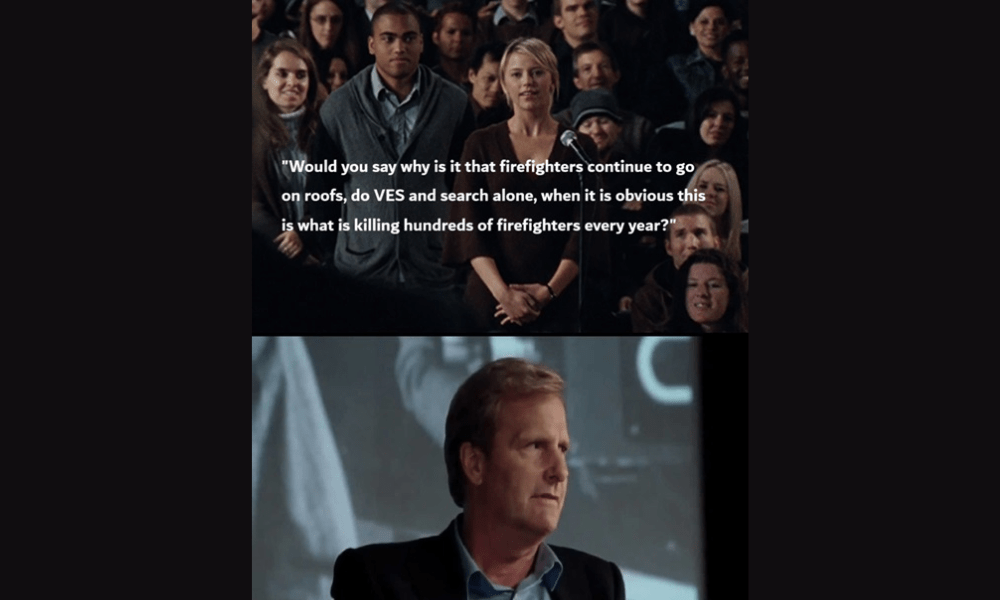
Image courtesy of HBO.
 Data Not Drama