
By Bill Carey
3 August 2025
Will your department face a Uvalde backlash in the name of risk management?
Introduction
Victim Survivability Profiling (VSP) is a controversial approach to fireground decision-making that attempts to assess whether a trapped occupant is likely to be alive before committing firefighters to a search and rescue. While framed as a risk management tool, VSP introduces significant risks of its own, especially when used to justify withholding or delaying rescue efforts. This practice carries serious legal liabilities, ethical conflicts and psychological burdens for firefighters, particularly in a profession already grappling with a mental health crisis.
Read: The Risk of Assumption: Rethinking Victim Survivability Profiling in Firefighting
The tragic death of Loretta Pickard in Polk County, Florida, highlights the dangers of deferring rescue under the assumption of low survivability. Her case, among others, has intensified debate over the use of VSP and whether it undermines the core mission of the fire service: to save lives.
The Loretta Pickard Case: A Cautionary Example
In 2018, 76-year-old Loretta Pickard died trapped inside her burning home in Polk County, Florida. While she pleaded for help on the phone with 911 for over 20 minutes, firefighters remained outside, citing concerns about fire conditions and structural stability (WFTS Tampa Bay, 2019). Audio recordings revealed her cries as she succumbed to the fire. Subsequent investigations did not show a collapse that would have made interior operations impossible (Bousquet, 2019).
Pickard’s death became a focal point for critics of VSP-like decision-making. The case raises disturbing questions: Was the decision to remain outside based on a calculated assumption of her survivability? If so, did that assumption override the duty to attempt rescue? The fallout included public outrage, media scrutiny, and a reevaluation of local fire department policies. It also showed how these decisions—made in minutes—can have lifelong consequences for everyone involved.
Legal Ramifications: Accountability After Assumptions
When firefighters decide not to attempt rescue due to perceived low survivability, they may expose themselves and their departments to legal liability. This is especially true when evidence later suggests a victim may have been savable.
Firefighters operate under a legal and moral duty to render aid when possible. Courts may scrutinize whether inaction represented a failure of duty, especially if it departs from accepted standards or department policy (Colwell, 2018). In the Pickard case, questions about whether established protocols were followed contributed to widespread calls for investigation.
VSP also poses a risk under the public’s evolving expectations for emergency response. In the wake of the Uvalde school shooting, where law enforcement delayed entry while victims were trapped inside, public and legal scrutiny quickly followed. A similar expectation is growing for fire departments: act decisively, especially when life is at stake (Texas House of Representatives, 2022).
Moral Conflict and Ethical Consequences
VSP shifts the burden of life-and-death decisions from physical limitations—such as fire impingement or collapse risk—to a moral judgment about whether someone is worth attempting to save. This contradicts a foundational ethic of the fire service: we search until we know.
When firefighters are asked to stand down based on probability rather than certainty, it can create moral injury—a condition characterized by guilt, shame, and inner conflict after violating one’s core moral beliefs (Litz et al., 2009). Unlike PTSD, which is fear-based, moral injury stems from ethical conflict and can erode confidence, purpose, and mental health over time.
In firehouses where courage and commitment are celebrated, the internal backlash from deciding not to search—and then learning a victim might have survived—can be devastating. It turns a decision meant to protect into a lasting source of regret.
The Mental Health Crisis in the Fire Service
Firefighting already ranks among the most psychologically demanding professions. According to the Firefighter Behavioral Health Alliance (FBHA), more firefighters die by suicide than in the line of duty annually (FBHA, 2024). Some contributing factors include cumulative trauma, high-stress incidents and feelings of helplessness or failure.
VSP introduces another stressor: the burden of assumed outcomes. Deciding not to enter, especially when outcomes are later questioned, adds emotional weight. Firefighters may replay those moments endlessly, wondering if they made the right call. That kind of uncertainty is corrosive, feeding depression, anxiety and long-term psychological injury (Meyer et al., 2012).
Additionally, as departments invest in PTSD and suicide prevention programs, they must consider whether their operational tactics—like VSP—are increasing mental health risk rather than reducing it.
Contradiction with Rescue Data and Culture
The growing body of data about rescues directly challenges the assumptions VSP is based on. The Firefighter Rescue Survey, which compiles thousands of real-world civilian rescues, finds that viable victims are frequently located in areas firefighters might otherwise consider unsurvivable based on conditions alone (Firefighter Rescue Survey, 2025). Black smoke, high heat or extended fire duration do not reliably predict victim outcome (Peacock, 2023).
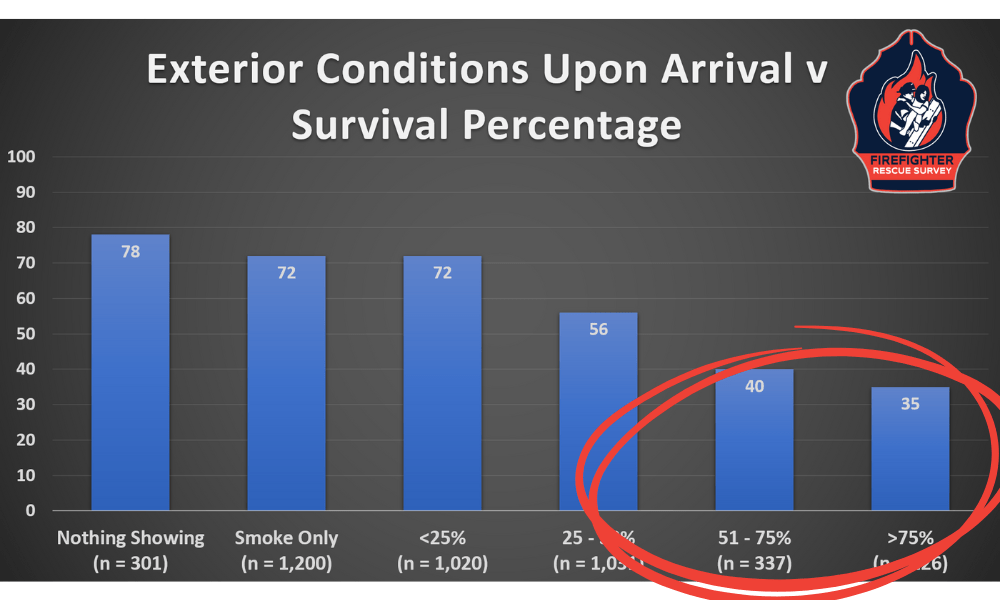
Yet VSP encourages firefighters to predict outcomes based on these very cues. This not only decreases the likelihood of victim rescue, it also shifts fire service culture away from action and toward avoidance. Over time, this erodes the core identity of the firefighter as a rescuer, replacing it with that of a risk calculator.
Conclusion: Stop Predicting, Start Searching
VSP may appear logical in theory, but its application carries profound legal, ethical, and psychological consequences. The fire service cannot afford to institutionalize assumptions in place of action, especially in a profession already burdened by trauma and public scrutiny.
The tragic death of Loretta Pickard serves as a warning: when we rely on predictions instead of performing searches, we risk failing the very people we’re sworn to protect—and damaging the mental well-being of those who made the call. Firefighters need data-informed tactics, not fear-driven retreat. They deserve the support to act, not the burden of deciding who might already be dead.
Fireground decisions should be rooted in effort, data and logical SOPs, not assumption. Because the real risk isn’t just what’s inside the fire, it’s what we carry with us afterward.
References
Bousquet, S. (2019, March 15). Polk woman dies in house fire while pleading for help. Could she have been saved? Tampa Bay Times. https://www.tampabay.com
Colwell, J. (2018). Legal considerations in fire service operations. Fire Engineering.
Firefighter Behavioral Health Alliance. (2024). Annual suicide report. https://www.ffbha.org
Firefighter Rescue Survey. (2025). Annual findings: Civilian victim rescue data from U.S. fireground operations. https://www.firefighterrescuesurvey.com
Litz, B. T., Stein, N., Delaney, E., Lebowitz, L., Nash, W. P., Silva, C., & Maguen, S. (2009). Moral injury and moral repair in war veterans: A preliminary model and intervention strategy. Clinical Psychology Review, 29(8), 695–706. https://doi.org/10.1016/j.cpr.2009.07.003
Meyer, E. C., Williamson, V., Elhai, J. D., & Lopez, C. M. (2012). PTSD and moral injury: Implications for mental health care in the fire service. Journal of Traumatic Stress, 25(5), 586–589.
Peacock, R. D. (2023). Tenability criteria and victim survivability in structural fires: A review of contemporary models. National Institute of Standards and Technology.
Texas House of Representatives. (2022). Robb Elementary Shooting Investigative Report. https://house.texas.gov/_media/pdf/committee-reports/87RobbElementaryShootingReport.pdf
WFTS Tampa Bay. (2019, March 14). 911 calls released in Polk County house fire that killed woman. https://www.abcactionnews.com/news
Title photo courtesy of NPR/Associated Press.
 Data Not Drama