By Bill Carey
14 August 2024
14 August marks 13 years since a firefighter was killed while engaged in vertical ventilation due to a roof collapse.
On 14 August 2011, Dallas Lieutenant Todd Krodle and the crew of Ladder Company 26 responded to an apartment fire a few minutes after 4:00 p.m. According to various reports, Lieutenant Krodle and another firefighter were assigned ventilation. After the two walked to the ridge Krodle fell partially through the roof and became trapped. During the initial attempt to free Krodle, he fell completely through the roof and was eventually freed from the ceiling space by firefighters below him on the second floor.
The United States Fire Administration listed Krodle’s cause of death as collapse and asphyxiation as the nature of death.
It wasn’t a truss collapse
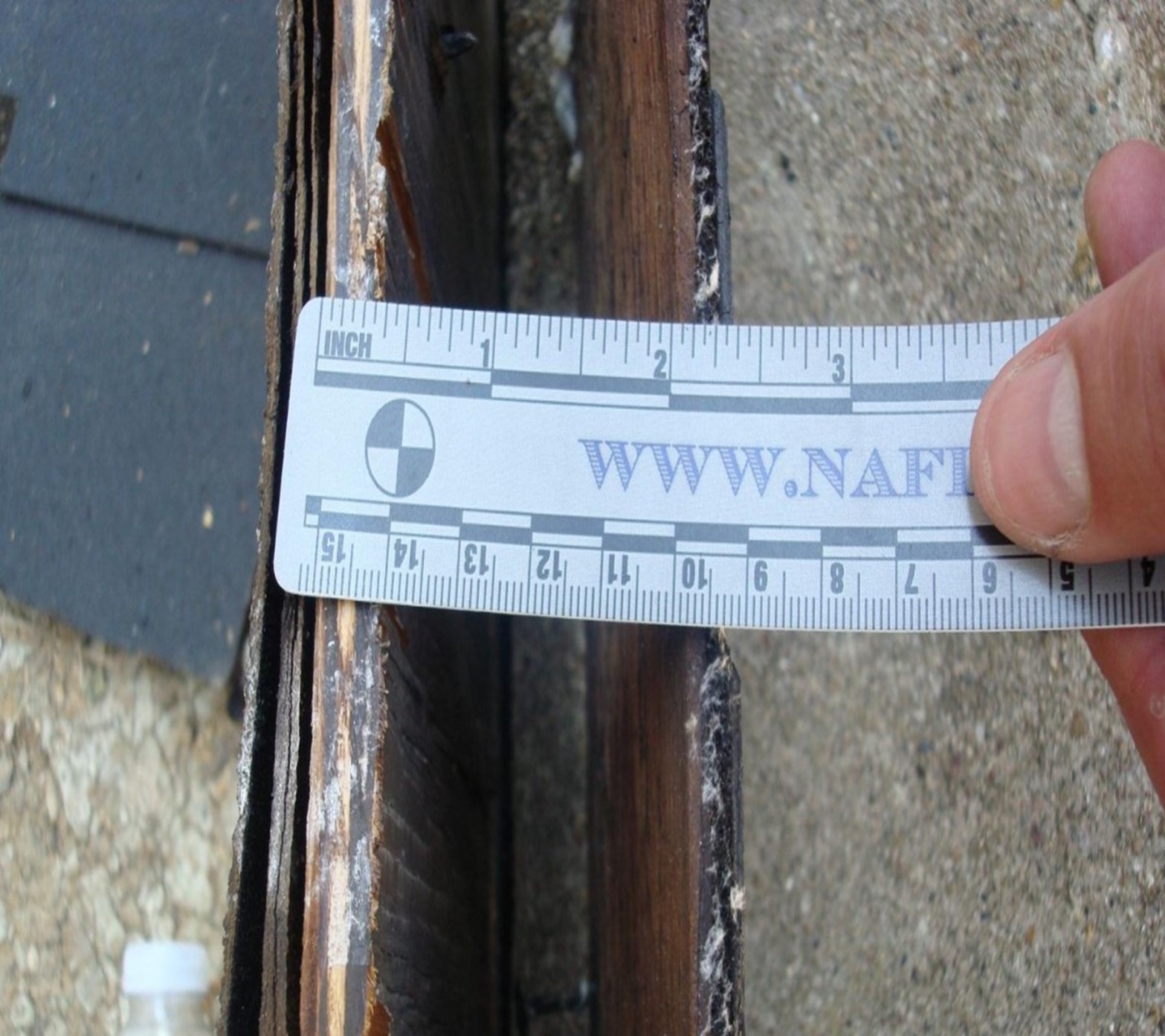
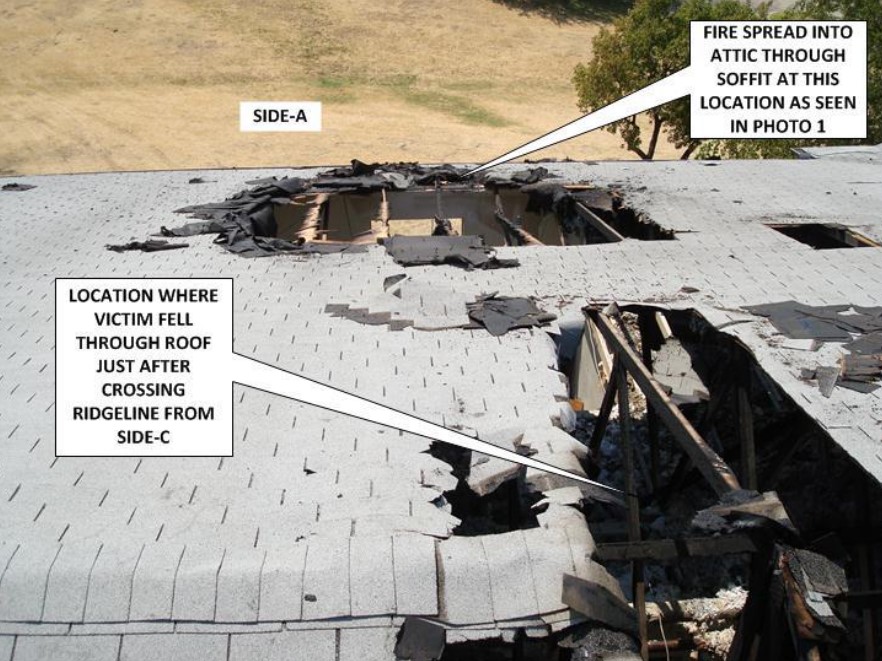
The fear of roof truss collapse is a common statement seen and heard regarding vertical ventilation. The fire began in a first-floor bedroom and extended out a window, up the brick and wood exterior veneer, through the soffit and into the attic space [1]. NIOSH investigators examined the roof directly above the fire-affected apartment, finding that the lightweight wooden trusses were covered with 3/8-inch plywood and asphalt shingles [2]. The roof deck was constructed in the 1970s and was thinner than what modern building codes would require, according to NIOSH.

plywood measures 3/8-inch. The one on the right was taken from the roof in the vicinity of
where the victim fell through. It has minimal fire damage and shows one layer of the plywood
has been compromised in several places. (NIOSH photo)
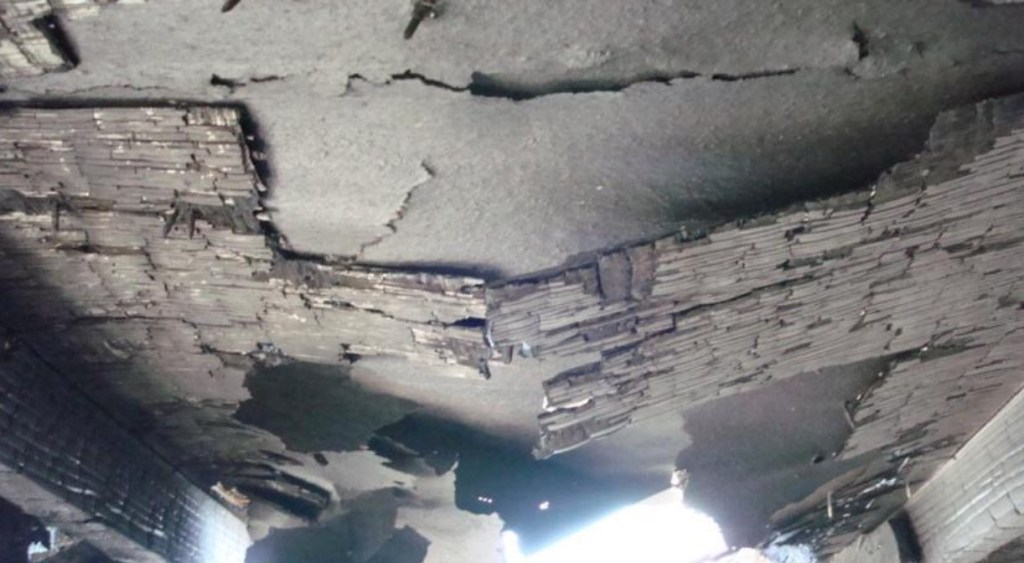
Examination of the roof assembly in the attic space by the state fire marshal’s office revealed significant charring of the truss members. In some areas near the ridge line, the plywood roof decking was burned through, exposing the felt paper underlayment, with only the shingle layer remaining intact above [3].
Victim’s movements
The first due engine saw fire in a first-floor bedroom on Side Alpha. The fire had not yet vented through the window. Ladder Company 26, the second-due truck company, arrived within four minutes of the first engine and positioned on Side Bravo to get close to the structure. The bulk of the fire was extinguished by the first engine. A bystander alerted the second-due engine to a fire in the eaves, prompting the crew to advance their line to the second floor.
Krodle and the other firefighter laddered the roof on Side Charlie. Krodle carried a chainsaw and the other firefighter carried an ax. Both moved towards the ridge and Side Alpha. Neither was wearing gloves, hood or were on-air with their SCBA. The other firefighter had dropped his ax as he got onto the roof and when he picked it up he saw a hole where Krodle had been standing, the saw near the hole, and a lot of smoke. The firefighter tried to pull Krodle out of the hole but could not because he was not wearing gloves. Firefighters underneath in the second-floor apartment could see the reflective trim of Krodle’s pants and began to try and remove him.
“Lt. Krodle was in an upright position in the attic supported by framing against his back and straddling ceiling joists and electrical cables with his boots dangling below the bathroom ceiling. The E16 Lieutenant removed his SCBA mask and attempted to place it over the face of Lt. Krodle, but he could not reach him. E16 Lieutenant alternated breaths through his SCBA mask between himself and attempts to place the mask over Lt. Krodle’s face during extrication and rescue effort [4].”
Krodle’s rescue was hampered due to him being entangled in wiring, the ceiling framing and the limited amount of space below him (bathroom) for rescuers to work in.
The reports
Both the state fire marshal’s report and the NIOSH report mention the lack of PPE, especially not being on air.
The NIOSH report states that the roof components were damaged in a previous fire [5]. Each report states “The complex has a known history of recent fires,[6]” and “This apartment complex has had multiple fires over the years [7].”
The NIOSH report goes on to call the ventilation task at this fire a “Low Frequency/High Risk” event because “the roof decking material was not structurally sufficient to support vertical ventilation operations [8].” The use of SCBA is low on the NIOSH report’s list of recommendations.
Ventilation deaths since
There have been eight firefighter fatalities related to ventilation since Krodle’s death, yet none involve roof collapse. Here are those deaths:
Victim fell while moving from roof of exposure building to roof of fire building: 1
Victim suffered a heart attack and fell off the roof: 1
Victim suffered a heart attack after positioning a ground ladder: 1
Victim suffered a heart attack after ventilation training: 1
Victim was thrown from tower ladder bucket after it was stuck on parapet: 1
Victim fell through skylight: 2
Victim’s activity type is incorrectly listed: 1
From 1991 to 2023, the USFA lists 39 traumatic and non-traumatic firefighter fatalities under the activity type “Ventilation.” To date a total of two firefighters died falling through a roof due to collapse; Krodel in 2011 and a Louisville firefighter in 1994. Two died after falling through the opening made during ventilation. Three have died falling off the roof, and six died due to a heart attack while on the roof. Three times the number of those killed in a collapse died due to heart attacks [9].
Absence doesn’t negate risk
Caution must be used when discussing the data of firefighters killed while doing ventilation. Actual, referenced facts can easily render fear-based positions invalid but we must be aware that a low number of fatalities in a certain activity type or sub-category do nothing to the risk involved. It is important to understand why some have an adverse attitude towards ventilation [10] and how their beliefs are reaffirmed. Discussion introducing facts helps alleviate the fear while still accepting that what someone else’s department does or does not do is fine by you if you don’t work there.
A firefighter could be opening a roof tomorrow and be killed in a collapse.
References
- TEXAS STATE FIRE MARSHAL’S OFFICE Firefighter Fatality Investigation Investigation Number FY 11-07 Lt. Todd Krodle Dallas Fire-Rescue August 14, 2011. (n.d.). https://www.tdi.texas.gov/reports/fire/documents/fmloddkrodle.pdf
- Career Lieutenant Dies After Being Trapped in the Attic After Falling Through a Roof While Conducting Ventilation – Texas. (n.d.). https://www.cdc.gov/niosh/fire/pdfs/face201120.pdf
- TEXAS STATE FIRE MARSHAL’S OFFICE Firefighter Fatality Investigation Investigation Number FY 11-07 Lt. Todd Krodle Dallas Fire-Rescue August 14, 2011. (n.d.). https://www.tdi.texas.gov/reports/fire/documents/fmloddkrodle.pdf
- ibid
- Career Lieutenant Dies After Being Trapped in the Attic After Falling Through a Roof While Conducting Ventilation – Texas. (n.d.). https://www.cdc.gov/niosh/fire/pdfs/face201120.pdf
- TEXAS STATE FIRE MARSHAL’S OFFICE Firefighter Fatality Investigation Investigation Number FY 11-07 Lt. Todd Krodle Dallas Fire-Rescue August 14, 2011. (n.d.). https://www.tdi.texas.gov/reports/fire/documents/fmloddkrodle.pdf
- Career Lieutenant Dies After Being Trapped in the Attic After Falling Through a Roof While Conducting Ventilation – Texas. (n.d.). https://www.cdc.gov/niosh/fire/pdfs/face201120.pdf
- Ibid
- “How Did We Become Scared of the Roof?” 2023 presentation to the Maryland State Firefighters Association/USFA data
- How Did We Become Scared of the Roof? (n.d.). https://data-not-drama.com/2023/10/15/how-did-we-become-scared-of-the-roof-the-visual/
Featured image courtesy of NIOSH.
 Data Not Drama