
If the news is bad and it’s not yours to carry, leave it alone
By Bill Carey
18 February 2024
In 1943 The Advertising Council, Inc. was renamed The War Advertising Council, Inc. by the United States Office of War Information. The renaming carried a new purpose of coordinating the country’s advertising industry in support of the war effort during the Second World War.
Posters were part of that effort and some had a focus on keeping servicemen and civilians from allowing careless talk to jeopardize lives overseas and at home.
Britain recreated their World War I Ministry of Information during the Second World War to also create posters to positively influence civilian attitudes towards the war effort. Careless talk was one of many poster themes created to discourage people from discussing sensitive information that may be overheard by spies.
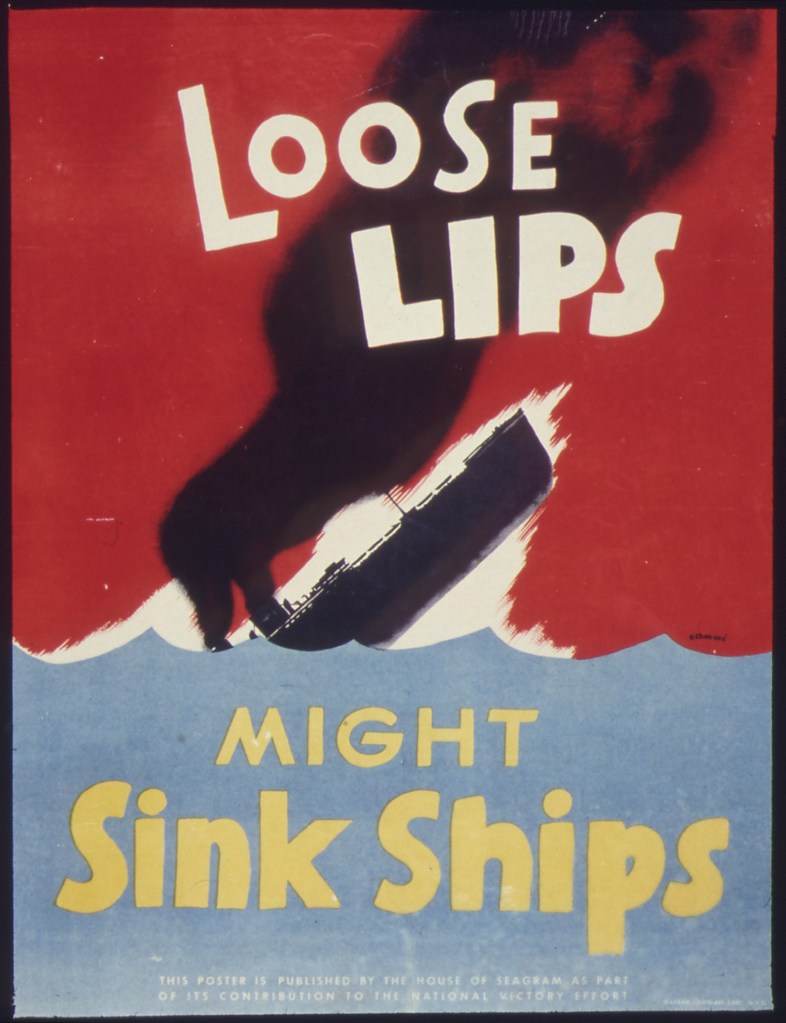
In the United States the “Loose Lips Might Sink Ships” poster became the expression “loose lips sinks ships,” and became the caution towards speaking carelessly in public and causing harm.
From the 1940s and up until the advent of the internet and social media, news of tragedy came to us through broadcast media. Our knowledge came from what was read or heard, or what was told to us by someone who was at the incident. Everything else was hearsay.
During the World Wars, the Korean War and the Vietnam War, notifications about the death of servicemen were sent to families in telegrams. They were often received months after the fatal incident and in the case of prisoners of war, many months passed between the notifications about missing in action to the notifications about being a prisoner.
The imagery of receiving a wartime telegram is easily understood. A Western Union messenger would arrive at the family home, knock on the door, and hand the telegram to the spouse or parents, leaving them alone with the sudden shock to come after reading the information.
During the Vietnam War, in 1965, the use of the telegram messenger was seen as being insensitive. The telegram messenger was replaced by a uniformed officer and a chaplain. With the change came a new imagery, the spouse looking out the window, seeing two men in uniform get out of a government-issued vehicle and walk to the door.
The shock from the opening of a telegram was replaced by the shock of hearing the doorbell.
Communication and communicating are two very different subjects that share common values. Each has some form of instruction, rules, guidance and ethics that are reviewed, altered or unchanged by cultural values and technology over time.
Social media is probably the greatest influence – for good and bad – in both subjects mainly in the speed at which information is delivered. For the fire service, we are in an age where news of a fireground tragedy can be read, seen and heard well before the firefighters involved have returned to their firehouses. Users are quick to post a call for prayers, a fire department logo with a black band, or literally state that a firefighter or firefighters were killed, well before any official source releases the information.

Hand-in-hand with such immediate and impersonal posts about a tragedy is the dopamine release that posters feel when they see their post commented on, shared and liked. Cognitive neuroscientists have shown the relationship between social media and the release of dopamine based on engagement of social media posts. Online pleasure produces a behavior that causes a person to repeat the behavior for the same reward. Being the first to post news about a tragedy – and to have that news shared – creates a sense of self-importance and thus a positive inner value that leads the poster to desire to have that same importance again.
Keep in mind that the poster does not have to be connected to the incident in any way tangible – personally and professionally.
Last week during the explosion in Loudoun County, Virginia, well before there was any word of a firefighter fatality, users of X, formally known as Twitter, and Facebook had posted that a firefighter was killed. In my position as a news editor, it is common for some of my contacts in the fire service to text me or call me letting me know about a line-of-duty death. Sometimes they are members of the department involved and let me know that the official word is coming. Other times they have heard the news from a friend on the scene or in the area. Professionally this has been good to know as I wrote the first draft of the news story or prepared an update to the original story. However, unless the friend is an official of the department involved and has given me permission to use their statement, the news about the death does not get posted.
The fire service as a whole should follow the same advice. I understand it is your page, your profile and that “the news will come out anyway” (a callous train of thought in my opinion). You are not doing anyone a favor for trying to be the first to post about it. Instead, you are making it worse for spouses and families.
In an article about the death of her husband, Lieutenant Brad Clark, Melanie Clark described how she first began the know that something had gone wrong while Brad was at work.
“The night of the crash, Melanie began to get phone calls. Nobody could really tell her anything because, frankly, they probably didn’t know anything themselves. They had only heard of the event, so they were mainly just asking questions: “Have you talked to Brad?” “There’s been an accident on 295 – have you heard from Brad?”
After a phone call or two, she texted Brad – no answer. Doubt began to creep into her mind, but she thought, nothing bad could happen to Brad – he would call soon. Then Facebook started to light up with sentiments like, “Prayers for station 6, there was a fatality.”
It became clearer to Melanie that this was more than just another call. She dropped to her knees and started screaming.”
This is not an isolated incident. I have heard of widows who learned about injury to or the loss of their spouse through tasteless social media posts. They see the posts and make calls to the proper officials and discover that the official at times is unaware of the tragedy, or at best does not have all of the details.
I have also experienced times when an incorrect number of the fallen has been shared on social media. One news story I always recall had the number set, then it increased and in a later update it decreased – and that was from an official source.
Social media is a great connector keeping us in touch with one another, and living electronically together, but it can be a cruel messenger carrying unconfirmed and incorrect information. To avoid using it as the latter in times of a likely fireground tragedy the best action to take if you hear something not from an official source is to let it alone.
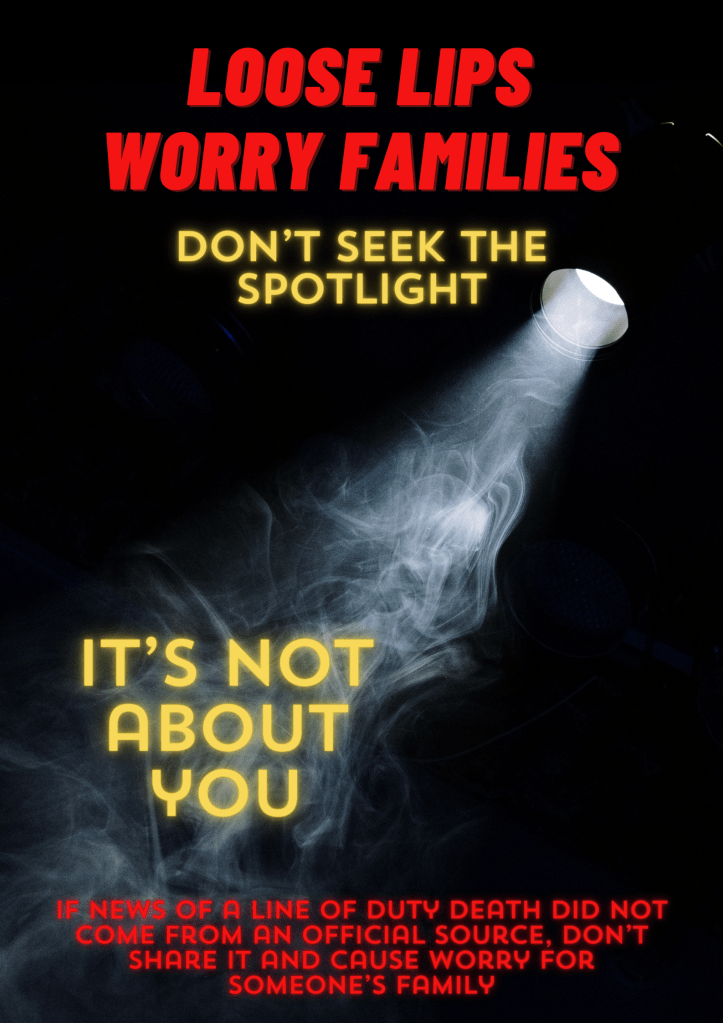
Do not post if the information did not come from an official source.
In the heat of the moment, details are cloudy and misunderstandings can easily be presented as fact. Do not add to the fog or information with unvetted information. Think of the reversed roles and how your spouse and family might feel reading about a death where you are working. The adage “If you can’t say something nice, don’t say anything at all,” isn’t limited to speaking ill of someone. Leave the delivery of tragic news to the officials involved, even if it is just social media, and go get your dopamine hit from something pleasant.
One more thing. In the wake of a tragic line-of-duty death, don’t be that asshole that immediately finds blame with the department. I saw that too regarding Loudoun County.
Featured photograph courtesy of USMC Archives from Quantico, USA – Death Notification Telegram, 1944, CC BY 2.0, https://commons.wikimedia.org/w/index.php?curid=42679368
 Data Not Drama