By Bill Carey
22 October 2026
Firefighters do not develop their operational beliefs in isolation. From the start of their careers, they learn not only through formal instruction, department policies, and practical experience, but also by observing other firefighters’ behaviors, attitudes, and decisions. They pay attention to how experienced members operate, which tactics are praised, which hazards receive the most attention, and which decisions are criticized. Over time, these observations help establish a shared understanding of what constitutes competent, professional, and acceptable firefighting.
In social psychology, this process is closely associated with social proof, or the tendency to look to others’ behaviors and opinions when deciding what to believe or how to act, particularly when a situation is uncertain. When individuals lack enough information to make an independent judgment, they often use others’ actions as a substitute for direct evidence. The underlying assumption is that if many people, especially those perceived as knowledgeable or experienced, believe something is true, their collective judgment must have merit.
This tendency is not inherently problematic. Firefighting is a complex occupation in which experience, mentorship, and shared learning are essential. Observing experienced firefighters can help less experienced personnel recognize hazards, understand operational expectations, and develop sound decision-making skills. The problem arises when social media replaces critical evaluation instead of serving as a starting point.
Historically, operational beliefs were shaped primarily through department culture, firehouse and shift culture, training academies, senior personnel, conferences, trade publications and professional relationships. Today, a firefighter can encounter the opinions of instructors, chiefs, consultants, and prominent members of the fire service every time they open a social media platform. These individuals can reach audiences far beyond their departments and geographic regions, influencing how thousands of firefighters think about fire behavior, building construction, tactical ventilation, interior fire attack, personal protective equipment, and acceptable operational risk.
The result is a professional environment in which operational beliefs can be shaped not only by formal training and research, but also by visibility, repetition, perceived authority, fandom and the apparent agreement of others.
Can Popularity Become A Substitute For Evidence?
Social media creates a visible hierarchy of influence. An individual or individuals can accumulate large followings, receive substantial engagement, and become recognized as authorities within particular areas of firefighting. Some can even employ marketing services to promote their messages. Their posts may attract hundreds or thousands of likes, shares, comments, and endorsements from other respected professionals.
These engagement metrics can create an impression of credibility. A widely shared post may appear more authoritative than a technical report that receives little attention. An instructor with a large following may be perceived as more knowledgeable than a researcher whose work is less visible. A tactical opinion repeated by several prominent figures may start to seem like an established professional consensus, even when the underlying evidence is limited, contested, or more nuanced than online discussions suggest.
Social validation and factual validation are not the same. Social validation occurs when people accept an idea because others seem to support it. Factual validation requires examining whether reliable evidence, sound reasoning, and appropriate application to the circumstances support the idea.
In a large-scale experiment, Muchnik, Aral, and Taylor (2013) demonstrated that artificially introduced positive ratings could influence subsequent users’ evaluations, creating a herding effect in which people were more likely to endorse content that already appeared to be favored by others. Its findings show how visible approval can influence individual judgment regardless of an idea’s underlying merits.
When influential members repeatedly endorse a tactical claim, firefighters may become less inclined to question it. The claim’s popularity becomes part of its persuasive power, and the distinction between what many people believe and what the available evidence supports begins to disappear.
Repetition Creates The Appearance of Consensus
When firefighters encounter the same operational claim across multiple posts, videos, podcasts and comment threads, the idea can begin to feel increasingly familiar and credible. This is the illusory truth effect, in which repeated exposure to a statement can increase the likelihood that people judge it to be true.
A statement may feel credible because it has been seen, read or heard repeatedly, but not because the firefighter has independently evaluated the evidence supporting it.
Social media can intensify this effect because multiple appearances of an idea do not necessarily represent multiple independent sources of information. Several instructors may share the same original post. A department may repeat a claim first encountered in a training video. An influencer may cite another influencer, who originally based the argument on an anecdote rather than research. To the observer, the claim appears to have broad support, even though every repetition may trace back to the same limited source.
This can create an echo chamber where dissenting opinions may be absent, receive little engagement, or be dismissed as uninformed. Over time, firefighters may develop the impression that a particular tactical position represents the profession’s accepted view.
Research on online social influence supports this broader concern. Muchnik et al. (2013) found that positive ratings could generate a herding effect in which subsequent users became more likely to endorse content that already appeared popular. The study does not demonstrate that firefighters adopt unsafe or hyper-safe tactics because of social media. Still, it does establish a plausible mechanism through which visible agreement can shape online judgments.
Social Proof Can Influence Risk Perception
The relationship between social proof and operational beliefs becomes especially important when considering how firefighters perceive danger.
Risk perception is not determined exclusively by objective probabilities. Experience, emotion, familiarity, perceived control, and how information is communicated also influence it. Research on firefighters has identified differences in risk perception tied to occupational context and the characteristics of the risks being evaluated.
When respected members of the fire service give a particular danger sustained attention, firefighters may come to regard it as more prevalent, more likely to produce a catastrophic outcome, or harder to control than they previously believed. Conversely, hazards that receive little online attention may seem less important, even when they remain operationally significant.
This can create an imbalance in the way risks are mentally prioritized.
For example, repeated exposure to dramatic accounts of a particular type of line-of-duty death may make that outcome especially accessible in memory. If influential voices repeatedly use those incidents to support a broad tactical conclusion, the emotional impact of the events may become intertwined with the perceived authority of the people discussing them. The resulting belief can feel strongly supported even when the available examples do not establish how frequently the outcome occurs or whether the proposed tactical response would reduce overall risk.
Social proof can therefore influence more than what firefighters believe to be true. It can influence which dangers they prioritize, which operations they consider acceptable, and which decisions they regard as professionally responsible.
The Pressure To Conform
Social proof also has a social dimension. Firefighters do not evaluate operational ideas solely as individuals; they belong to departments, professional networks, and occupational cultures in which belonging and reputation matter.
When a respected group strongly endorses a tactical philosophy, questioning it can carry perceived social costs. A firefighter who disagrees may worry about being labeled inexperienced, overly cautious, reckless, or resistant to change. On social media, those costs can show up as public criticism, dismissive comments, ridicule, or the withdrawal of professional approval.
Consequently, agreement does not always indicate genuine conviction. Some individuals may publicly support a position because they believe it is expected, while others may remain silent despite legitimate concerns.
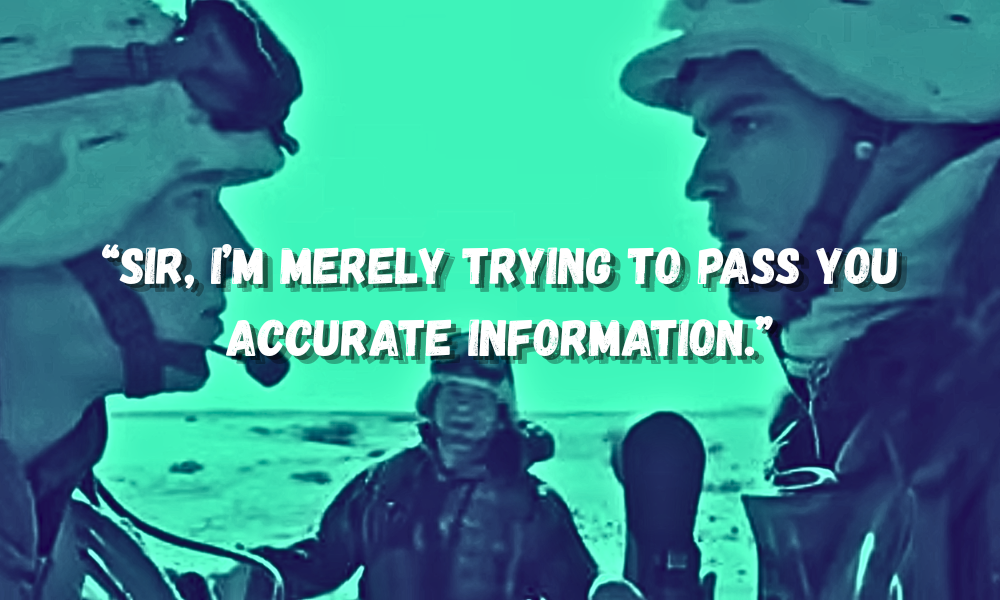
In HBO’s Generation Kill, Lieutenant Nathaniel Fick faces a familiar problem in high-risk organizations: a superior has made a decision, but the information supporting it is questionable and the consequences could endanger the people under his command.
“Sir, that’s way inside danger close. Cancel the mission,” Gunny Wynn said with growing alarm.“We’re shooting it. Keep quiet,” he replied.
“It’s an empty field!” I shouted. “We’re watching it. You’re going to hit us with the rounds, and probably RCT-1, too, since we don’t know when they’ll be coming up the road. Cancel the fucking mission.” I reached to take the radio handset from him.”
Fick, N. (2005). One bullet away: The making of a Marine officer. Houghton Mifflin.
Challenging the order carries professional and social risks. Going along with it may be easier, particularly when the decision comes from someone with greater rank and authority. But agreement does not make the decision correct.
Firefighters face a similar challenge when an operational belief becomes accepted by a department, a respected instructor, or a large online community. The pressure to conform can make questioning the prevailing view feel like questioning the people who hold it.
The lesson is not that authority should be ignored. It is that authority, experience and consensus should never replace critical evaluation of the information available.
People often look to authority figures and respected peers to determine what is acceptable. In a strong hierarchy, questioning a decision can be interpreted as a lack of confidence, courage or loyalty.
Evidence Must Outweigh Engagement
The solution is not to dismiss social media, disregard experienced instructors, or assume that popular operational beliefs are necessarily wrong. Social platforms can disseminate valuable lessons, expose firefighters to new research, and encourage professional discussion across departmental boundaries.
The objective should be to build a culture in which an idea’s popularity does not determine its credibility.
Firefighters, instructors, and department leaders can help achieve this by asking several questions when evaluating influential operational claims:
- What is the original source? Is the claim based on peer-reviewed research, an investigation, established guidance, practical experience, or an unverified anecdote?
- Is the evidence independent? Are multiple sources providing separate evidence, or are they repeating the same original claim?
- What is the scope of the conclusion? Does the evidence support a universal rule, or does it apply only under particular conditions?
- What evidence might challenge the claim? Have alternative explanations, limitations, and potential unintended consequences been considered?
- Would the conclusion be accepted without the person’s reputation or the post’s engagement metrics? This helps separate the persuasive power of the messenger from the strength of the argument.
Department leaders have a particular responsibility to create environments where evidence-based disagreement is welcomed. Training should encourage firefighters to explain the reasoning behind tactical decisions, evaluate competing approaches and understand the limitations of both research and experience. Post-incident reviews should examine decisions in context rather than treating the outcome alone as proof that a tactic was either correct or incorrect.
Ultimately, social proof is a normal feature of human judgment. It helps people learn from one another and navigate uncertainty. The danger arises when people mistake the collective confidence of a professional network for independent verification.
References
1. Muchnik, L., Aral, S., & Taylor, S. J. (2013). Social influence bias: A randomized experiment. Science, 341(6146), 647–651. https://doi.org/10.1126/science.1240466
2. Tchiehe, D. N., & Gauthier, F. (2017). Risk perception: A critical review of the literature and its application in the field of occupational health and safety. Safety Science. Related publication search
Related
Data Not Drama. (2026, September 26). How social media reinforces existing fire service beliefs. https://data-not-drama.com/2026/09/26/how-social-media-reinforces-existing-fire-service-beliefs/
Fire Engineering. (n.d.). The Command Post: To search or not to search? https://www.fireengineering.com/firefighter-training/search-operations/the-command-post-to-search-or-not-to-search/
Fire Engineering. (n.d.). Tactical training for the fire service. https://www.fireengineering.com/firefighter-training/tactical-training-for-the-fire-service/


Leave a Reply