By Bill Carey
2 November 2026
Chat|AI
How emotionally charged language and social media influence fire service discussions, reinforce cultural divisions and shape perceptions of risk.
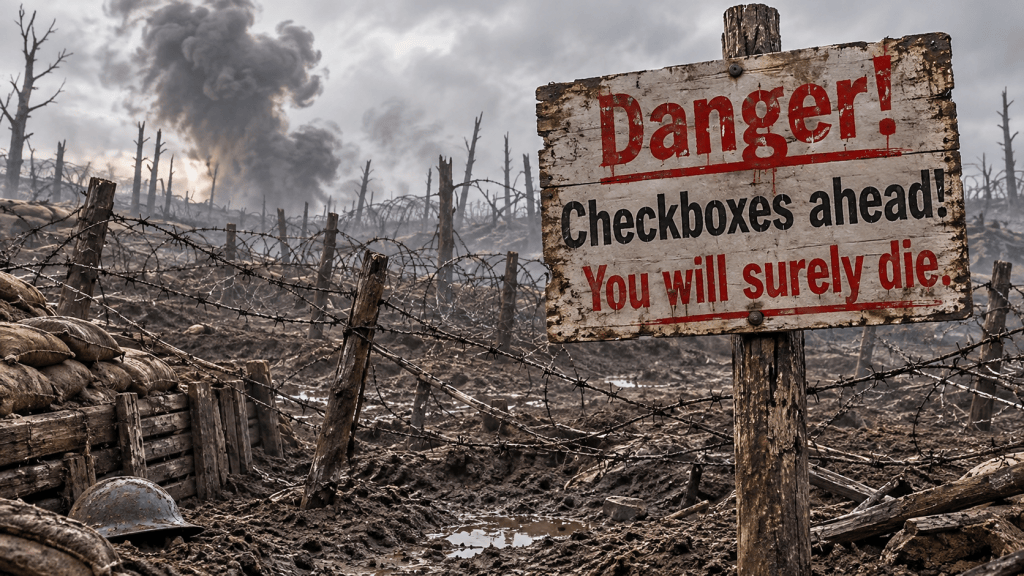
“That [checkbox nonsense] is killing the fire service, killing firefighters.”
Jeremy Donch, National Fire Radio; Task Force Tips | Facebook
It is a short statement, but it carries considerable rhetorical weight. It expresses frustration, assigns blame, invokes firefighter fatalities, and suggests a direct connection between administrative requirements and deaths on the fireground.
It also raises an important question: Is the statement supported by evidence, or is it an emotionally charged opinion presented as an established fact?
There is a difference between criticizing an administrative requirement, questioning the effectiveness of a training program, or challenging a department’s safety policies and claiming that those things are killing firefighters. The first three invite discussion. The last attempts to establish a conclusion before the evidence has been examined.
This distinction matters in a fire service increasingly influenced by social media, where emotionally charged statements can travel farther, generate more engagement, and influence professional opinions more readily than measured explanations.
The problem isn’t that firefighters have strong opinions. They should. The problem develops when emotional intensity becomes a substitute for evidence and hyperbole becomes an accepted way of discussing firefighter safety.
Hyperbole as a Substitute for an Argument
Hyperbole is the use of exaggerated language to emphasize a point. It is common in everyday conversation, professional disagreements, political arguments and social media discussions.
In the fire service, hyperbole takes on a particular character. It is often connected to firefighter survival, tactical competence, leadership and the perceived dangers of administrative decision-making.
Consider statements such as:
- “This is what’s killing firefighters.”
- “Get off the roof.”
- “That policy is going to get somebody killed.”
- “Checkbox training is killing the fire service.”
- “That’s armchair quarterbacking.”
- “Nobody doing the job believes that.”
- “This is why firefighters are getting hurt.”
These statements are effective because they communicate more than disagreement. They communicate judgment, frustration and sometimes contempt.
They also simplify complicated subjects.
A discussion about training documentation becomes a discussion about whether administrators understand firefighting. A disagreement about ventilation becomes an accusation that someone is advocating dangerous tactics. A discussion about risk management becomes a debate about whether someone cares about the civilians or “them.”
The original issue quickly disappears beneath the emotional weight of the language.
Instead of examining whether a particular requirement improves training, whether a policy has operational value, or whether a tactical decision is appropriate under specific conditions, participants begin defending their professional identities.
That is not an especially productive environment for learning.
The Emotional Weight of Invoking Firefighter Deaths
Few subjects carry more emotional weight within the fire service than line-of-duty deaths.
Firefighters understand that the work is dangerous. They attend funerals, read LODD reports, watch memorial videos, and remember colleagues who never returned home. Consequently, statements that invoke firefighter fatalities have an immediate emotional impact.
When someone says, “This checkbox nonsense is what killing firefighters,” the statement does more than criticize administrative procedures. It places those procedures in the same rhetorical space as firefighter fatalities.
That is a significant escalation.
The statement implies a causal relationship between administrative requirements and deaths. Yet establishing causation requires considerably more than frustration with a policy or disagreement with a training philosophy.
Which firefighters have died because of the requirement?
What specific operational failure occurred?
Was the requirement responsible for that failure, or were other factors involved?
Is there documented evidence connecting the policy to the outcome?
Without those answers, the statement remains an opinion, not a demonstrated explanation of firefighter fatalities.
This does not mean administrative requirements are automatically effective, that every training mandate is worthwhile, or that departments cannot create unnecessary bureaucracy. Those are legitimate subjects for criticism.
But criticizing bureaucracy and attributing firefighter deaths to it are two different arguments.
The distinction should matter.
Social Media and the Policing of Fire Service Culture
Social media platforms have amplified discussions within fire service culture. Blunt, hyperbolic phrases are frequently used to instantly validate or dismiss an idea.
As presented in The “Taylor Swift Effect” and Fire Service Personalities on Social Media, influence within the fire service extends well beyond formal leadership positions. Popular instructors, online personalities, podcasts and social media groups can shape how firefighters interpret tactics, evaluate risk and form opinions about the profession. Their reach creates an opportunity to educate, but it also carries responsibility. Popularity is not proof of expertise, and confidence is not proof of accuracy. When influential voices use absolute statements, emotionally charged language or worst-case scenarios to dismiss opposing views, they can reinforce beliefs without establishing whether those beliefs are supported by evidence. Firefighters should evaluate not only what is being said, but who is saying it, what evidence supports it and whether important context is missing. Influence should encourage critical thinking, not replace it.
“Checkbox nonsense” allows the speaker to signal alignment with the frontline working-firefighter identity.
It draws a cultural distinction between those supposedly doing the work and those supposedly sitting behind desks creating policies.
This creates an artificial division between operational firefighters and administrators, instructors, safety officers, and others involved in developing training and policy.
It also encourages people to evaluate an argument based on who appears to be making it rather than whether the argument has merit.
Professional experience matters. Operational credibility matters. But neither automatically makes someone correct.
Likewise, working in an administrative position does not automatically make someone’s observations irrelevant.
The Working Firefighter Identity
Firefighting is more than an occupation. It is a professional identity built around competence, physical ability, teamwork, experience, and the ability to operate under dangerous conditions.
For many firefighters, tactical proficiency is not simply a job requirement. It is a survival mechanism. That helps explain why discussions about tactics, training, and safety can become intensely personal.
A criticism of a particular tactic may be interpreted as a criticism of the people who practice it. A discussion about training documentation may be interpreted as an attack on operational competence. A policy disagreement can become a question of whether someone understands what it means to do the job.
Social media provides an environment where these identities are constantly reinforced.
The language becomes tribal:
- Frontline firefighters versus administrators.
- Experienced firefighters versus inexperienced firefighters.
- Aggressive firefighters versus supposedly overly cautious firefighters.
- People who understand the job versus people who don’t.
These divisions make it easier to identify allies and opponents. They also make it harder to examine complicated subjects without assigning someone to one side or the other.
The statement becomes a signal of shared identity rather than an argument requiring evidence.
Worst-Case Scenarios and the Emotional Argument
Fire service discussions frequently rely on worst-case scenarios.
This is understandable to a degree. Firefighters are trained to recognize hazards, anticipate failure, and prepare for events that could result in serious injury or death.
However, there is a difference between identifying a credible worst-case scenario and using the worst possible outcome to establish that a particular decision, policy, or practice is inherently dangerous.
Consider the difference:
“This training requirement may not adequately evaluate a firefighter’s ability to perform the task under realistic conditions. We should examine whether the training objectives and evaluation methods reflect actual operational demands.”
And,
“This checkbox nonsense is … killing firefighters.”
The first statement identifies a potential problem and suggests an avenue for improvement. The second assigns blame and invokes fatalities without identifying a mechanism, incident, or supporting evidence.
The second statement may generate more immediate agreement, but it contributes considerably less to understanding the problem.
This is where emotional rhetoric becomes particularly problematic. When every disagreement is presented as a potential threat to firefighter survival, it becomes difficult to distinguish between genuine operational hazards and exaggerated claims.
Eventually, everything becomes a matter of life and death.
And when everything is described as potentially deadly, the language loses some of its ability to communicate which hazards actually deserve the greatest attention.
Emotion, Social Proof and the Reinforcement of Beliefs
Emotionally charged content is particularly well suited to social media.
Research by Brady and colleagues (2017) examined more than 563,000 social media messages concerning three contentious public policy issues. The researchers found that moral-emotional language was associated with greater diffusion of messages within social networks. Their findings suggest that emotionally charged language can help ideas spread, particularly among people who share similar group affiliations.
The study examined political and social issues on Twitter, not fire service discussions on Facebook. Its findings should not be treated as direct evidence about firefighter behavior. However, they offer a useful framework for understanding why emotionally charged statements can gain traction in online professional communities.
A blunt statement can become a focal point for an entire discussion, even when the original subject is relatively narrow.
A firefighter sees a statement criticizing administrative training. They agree because they have experienced what they consider unnecessary requirements. They like or share the post. Others with similar experiences respond.
The resulting discussion may create the impression that the original claim has been broadly validated.
But agreement is not evidence.
The number of likes, comments, or shares does not establish that a claim is factually correct. Nor does the popularity of an argument demonstrate that it represents the broader fire service.
People often use the opinions and behavior of others as information when evaluating an issue. On social media, visible agreement can make a position appear more credible or widely accepted than it actually is.
When that agreement is built around emotionally charged language, the original exaggeration can become normalized.
The conversation moves away from examining whether a claim is true and toward reinforcing the belief.
Emotion and the Perception of Risk
The relationship between emotion and risk perception is well established in behavioral science.
Slovic (1987) explained that people’s judgments about hazards do not always correspond with technical assessments of probability and consequence. Emotional reactions, familiarity, dread and other psychological factors influence how people evaluate risk.
Firefighter fatalities, dramatic fireground videos, images and accounts of near misses can produce powerful emotional responses. These experiences can influence how firefighters perceive the likelihood and severity of particular hazards. The same can occur with language.
When a policy is described as something that is “killing firefighters,” the phrase introduces a powerful emotional association. The audience may begin to perceive the policy as a direct threat to firefighter survival, even when no supporting evidence has been presented.
The emotional framing can become more memorable than the actual details of the issue. Emotional reactions should not be confused with measurements of risk.
A hazard should be evaluated based on its probability, potential consequences, exposure, operational circumstances, and available evidence—not simply how frightening or emotionally compelling a description makes it sound.
The fire service must be able to distinguish between what feels dangerous, what is demonstrably dangerous, and what can be done to reduce the risk.
Confirmation Bias and Motivated Reasoning
Firefighters rarely approach social media as completely neutral observers. They bring existing experiences, professional identities, operational preferences, and beliefs about how the job should be performed.
When someone encounters a statement that supports those beliefs, it may receive less scrutiny than a statement that challenges them.
Kunda (1990), in her review of motivated reasoning, explained how people’s goals and preferences can influence the way they access, evaluate, and interpret information. People may favor conclusions they want to reach while still constructing what appear to be reasonable justifications for those conclusions.
A firefighter who already believes that administrative requirements are undermining operational readiness may readily accept the claim that checkbox training is killing firefighters.
Someone who believes a particular tactic is inherently dangerous may interpret an incident involving that tactic as confirmation of the existing belief.
In both cases, the statement is evaluated partly through the lens of an established position.
The result can be a cycle:
- An emotionally charged statement supports an existing belief.
- The statement receives agreement and social reinforcement.
- The agreement increases confidence in the original belief.
- Contradictory information is dismissed or interpreted as evidence of the opposing group’s misunderstanding.
- Similar statements reinforce the belief over time.
The problem is not simply that firefighters disagree but when they become more interested in defending an established position than examining whether it is accurate.
The Responsibility of Manufacturers and Fire Service Professionals
The responsibility for accurate communication does not rest exclusively with individual firefighters participating in social media discussions.
Manufacturers, fire service organizations, instructors, consultants, department leaders, authors and influential fire service personalities also have a responsibility to ensure their statements are accurate, appropriately qualified, and supported by evidence.
This is particularly important when discussing firefighter safety, equipment, training, tactics and risk.
Manufacturers have a commercial interest in promoting their products. There is nothing inherently wrong with explaining the benefits of a product, demonstrating its capabilities, or comparing its performance with competing technologies.
However, marketing should not rely on exaggerated safety claims, selective statistics, or emotionally charged descriptions of the dangers associated with competing products or practices.
A manufacturer suggesting that a particular piece of equipment will prevent firefighter injuries or fatalities should be able to explain the evidence supporting that assertion. Product demonstrations, laboratory testing, independent evaluations, field experience and documented outcomes are different forms of evidence. They should not be presented as interchangeable.
The same responsibility applies to fire service personnel.
Instructors, consultants, authors and social media personalities often have considerable influence over how firefighters interpret information. Their professional experience and visibility can give their statements additional credibility, particularly among firefighters who look to them for guidance.
An instructor criticizing a particular tactic should accurately represent the research and operational circumstances involved. A consultant discussing firefighter fatalities should understand the data and definitions being used. A department leader criticizing a training requirement should be able to explain the operational shortcomings rather than simply dismissing it as administrative nonsense.
Likewise, someone promoting a particular training philosophy should not exaggerate the dangers of alternative approaches to make their own position appear more credible.
There is a difference between advocating for a position and manipulating the information used to support it.
Professional credibility should not provide an exemption from scrutiny. In fact, the greater the influence someone has over the fire service, the greater their responsibility to communicate accurately.
Being an experienced firefighter, respected instructor, recognized manufacturer, or popular social media personality does not make an inaccurate statement more accurate.
The fire service should expect the same standard from everyone: identify what is known, distinguish it from what is believed, acknowledge uncertainty, and provide evidence when making claims about firefighter safety. Commercial interests, professional reputations and social media engagement should never take priority over accuracy.
The Difference Between Passion and Accuracy
None of this suggests that firefighters should stop expressing frustration, challenging policies or questioning department leadership.
There are legitimate reasons to criticize administrative requirements, ineffective training, poorly designed policies and decisions that interfere with operational readiness.
There are also legitimate reasons to challenge tactics, question training practices, and examine whether established procedures are supported by current research and experience.
But passion does not establish accuracy. Experience does not eliminate bias. Confidence does not establish expertise. Popularity does not establish consensus, and invoking firefighter deaths does not automatically make an argument credible.
The fire service should be particularly careful about these distinctions because its discussions frequently involve decisions with serious consequences.
Calling something “nonsense” may communicate frustration, but it does not explain what is wrong with it. Saying something is “killing firefighters” may generate an emotional reaction, but it does not establish causation.
A Better Standard for Fire Service Discussions
The fire service does not need less passion. It needs more thoughtful, disciplined conversations.
When someone makes a statement such as “This checkbox nonsense is what killing firefighters,” the appropriate response isn’t necessarily to defend every administrative requirement or dismiss the speaker’s frustration.
It is to ask questions.
- What specific requirement are we discussing?
- What operational problem does it create?
- Is there evidence that it negatively affects firefighter performance?
- Is there a documented connection between the requirement and a firefighter fatality?
- What alternative would produce a better outcome?
These questions move the discussion from emotional positioning to professional examination.
There is nothing wrong with challenging conventional thinking. There is nothing wrong with questioning authority or criticizing policies that do not serve their intended purpose.
But disagreement should produce better questions, not increasingly exaggerated accusations.
The same standard should apply when evaluating claims made by manufacturers, instructors, consultants, and fire service personalities. Their credentials and experience may provide valuable context, but their claims should still be examined against the available evidence.
A professional discussion should be able to accommodate strong opinions while maintaining a clear distinction between facts, interpretations, speculation, and personal experience.
Popular Doesn’t Mean Right
The fire service has a long tradition of strong opinions, passionate disagreements, and professional debate. That is not inherently a problem. In fact, questioning practices and challenging assumptions are essential to professional development.
The problem occurs when the language used to express those disagreements becomes more important than the evidence supporting them.
Social media rewards bluntness, certainty and emotional reactions. It encourages people to reduce complicated issues to memorable phrases and to judge arguments through the lens of professional identity and group affiliation.
The responsibility for improving the quality of fire service discussions extends beyond individual firefighters. Manufacturers, instructors, consultants, organizational leaders and influential personalities have an obligation to communicate accurately. Their words can shape purchasing decisions, training priorities, tactical beliefs, and perceptions of risk across the profession.
That influence should be accompanied by accountability.
The fire service should not accept exaggerated safety claims simply because they come from a respected instructor, a familiar manufacturer, or someone with thousands of social media followers. Nor should it accept claims about firefighter fatalities without examining the underlying data and evidence.
There is room for strong opinions, disagreement, criticism, and passionate advocacy. There is no requirement that every discussion be polite or that every position receive equal consideration. But claims presented as facts should be supported by facts.
And professional credibility, commercial influence, or popularity does not excuse the responsibility to get the facts right.
References
1. Brady, W. J., Wills, J. A., Jost, J. T., Tucker, J. A., & Van Bavel, J. J. (2017). Emotion shapes the diffusion of moralized content in social networks. Proceedings of the National Academy of Sciences, 114(28), 7313–7318. https://doi.org/10.1073/pnas.1618923114
2. Kahneman, D. (2011). Thinking, fast and slow. Farrar, Straus and Giroux.
Provides background on intuitive thinking, cognitive biases, and the differences between rapid judgments and more deliberate reasoning.
3. Kunda, Z. (1990). The case for motivated reasoning. Psychological Bulletin, 108(3), 480–498. https://doi.org/10.1037/0033-2909.108.3.480


Leave a Reply