By Dave LeBlanc
21 October 2026
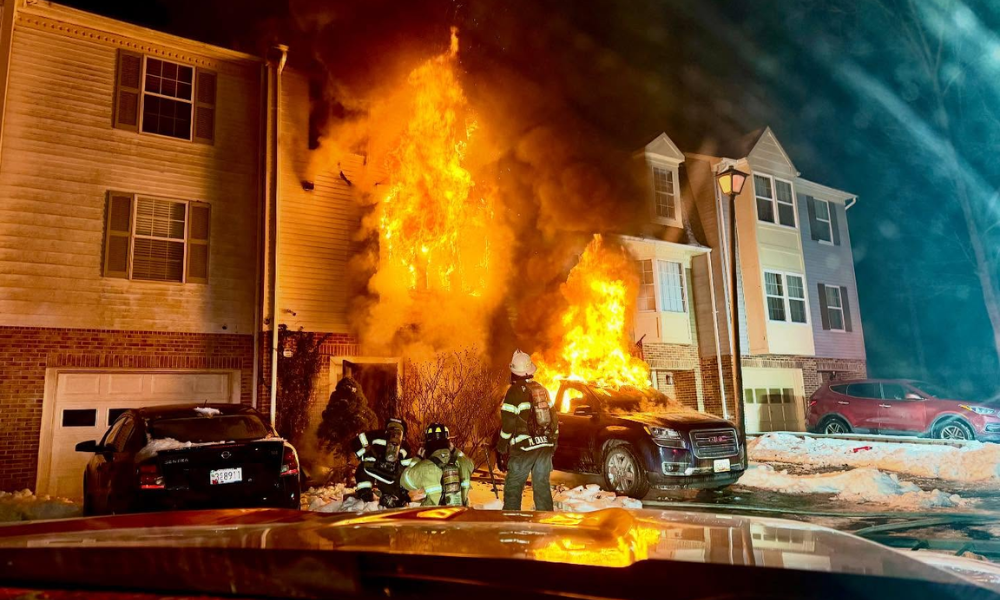
Photo|Prince George’s County Fire and EMS Department
I read a Facebook post the other day on ASMDSS (Awesome Stuff My Drill Sergeant Says), “Safety may be good for the midwife, but it isn’t good for the General.” The basic concept was, “Midwives protect the arrival. Generals decide the arrival is worth the cost and then lead through it.”
The post went on to say “Calculated risk, trained people, and a decision made in time save more lives than the checklist that arrives after the collapse.” Or as General Patton once said, “A good plan, violently executed now, is better than a perfect plan executed next week.”
We have all heard the quote “Perfect is the enemy of good.” It is attributed to Voltaire, who wrote “Le mieux est l’ennemi du bien” (The best is the enemy of the good) in the 1700s.
What Voltaire was saying is that if we wait for the best, we will never achieve good.
As incident commanders, we must play with the cards we are dealt and those cards look different on every fireground.
We live in an imperfect world and we are forced to act with incomplete information. This means two things: we must constantly reevaluate, and we must accept that we won’t always know the outcome.
This is why our size-up is so important, not just as an initial evaluation, but as a constant check to see if our decisions are having an impact. We want to be ahead of the fire; we need to decide to act based on what we think the fire will look like five minutes from now. We start behind the eight ball because of reflex time, travel time and the fact that someone had to discover the fire to call it in.
But once we decide, we need to listen to the cues. What is the building saying? What are the crews reporting? Is the smoke changing? We need to see whether our tactics are working, and to continue to support them if they are. Just as important, if they aren’t, we need to change them.
And in our imperfect world there is one immutable fact: the fire gets a say in everything we do. There are things we cannot know. Did the property owner make alterations? Are there hidden voids? Did the occupancy change? Are there more combustibles in the building than we expect?
These variables will work against us and, in most cases, there is no way we can tell from our size-up whether they are true. These changes will impact how the fire behaves, and they will make our tactics less effective. They will alter the plan.
Waiting for perfect is not an option. There will never be the right time to act, only the best time to act based on our resources and situation. All of our training and experience, combined with the knowledge of the skill set of our personnel, will go into every decision we make and every action we take. But it will never be the perfect choice because there will always be so many things we don’t know.
All we have to do is read any NIOSH report to see examples of things that weren’t known. Things that lead to injuries and deaths that were not known to companies as they arrive on scene. For example in NIOSH Report F2022-09 (Lieutenant Dies from a Floor Collapse in Residential Structure Fire with Unpermitted Renovations), this report details an incident where a 38-year-old fire lieutenant fell through a fire-weakened floor into the basement and died. Firefighters didn’t know the house had a full basement. Unpermitted renovations had covered the basement windows with boards painted to match the siding, and NIOSH lists those renovations among the contributing factors. Another example, NIOSH Report F2015-18 (Career Fire Fighter Dies After Falling Down Unsecured Elevator Shaft While Searching for the Seat of a Smoldering Fire), this report investigated the death of Chicago Firefighter Daniel Capuano, who fell down an open shaft in a vacant warehouse. City officials later said the owners had been removing the elevator and making other structural changes without authorization. The lack of barriers around the newly created void space in zero-visibility smoke directly caused the fatal fall.
Both of these reports are examples of the imperfect world we operate in, and how sometimes, in spite of our preparation things will still go bad.
The fire service is steeped in tradition, and the one tradition that should resonate the most is our oath to protect lives and property. We do this by taking the fight to the enemy, on his battlefield without all of the facts. But we do this because we swore an oath. We do this because a delay means our situation gets worse, not better. We do this because the citizens expect us to. We do this because we can’t wait for perfect, because it will never come.
So how do we overcome the unknown? Preparation.
“Gentlemen, we will chase perfection, and we will chase it relentlessly, knowing all the while we can never attain it. But along the way, we shall catch excellence.” – Vince Lombardi
Our excellence comes from our preparation. Every hour we train, we improve our skills. Every minute spent in our district improves our knowledge. Every class we take, every kitchen table review we sit through, these all feed the machine that is our mental Rolodex. They all form the basis for our knowledge, along with every fire we go to.
The limiting factor for most of us will be the number of fires we go to. No matter the hours you work, the fires you attend, it is unlikely that most will get the reps on the fireground to achieve excellence. Couple that with all the other variables we deal with: crew strengths and weaknesses, time of day, availability of companies, how long has the fire been burning, weather, the building and its past…and the cards are stacked against us.
What evens the playing field, to some degree, is our preparation. The more we know, the better our abilities, the bigger that Rolodex, the less likely we will be caught by surprise. We can never eliminate all the unknown and there is a reason the “inherent risk” label is applied to firefighting. But these risks can’t cause us to hesitate because waiting doesn’t make things better. Every minute the fire burns unchecked weakens the building and increases our risk.
Safety shouldn’t be a standalone task that halts our work. Safety isn’t first. The mission is first, and safety is a tool that is used to accomplish the mission. Safety should be inherent, built into every hour of training and preparation, so that when the time comes for us to act our safety is built in and we are free to operate in the most effective manner based on the fire in front of us.
We also overcome the unknown by borrowing the military concept of Commander’s Intent. Now like most military comparisons, it doesn’t quite fit into the fire service as written, but the overall concepts – clear goals and end state, understood at least two levels down, allow for adaptability to achieve the stated mission – fit well into our operational model.
Departments need to make sure the Commander’s Intent is clear. That is, they need to ensure our personnel know what the mission is and what is expected for results, and what defines success and failure. They need to know “the what” and more importantly “the why.” This will enable companies to operate on the fireground with clear expectations of their role. While this may seem like common sense, messages and expectations often get lost in the assumption everyone understands the goal.
Commander’s Intent also allows for disciplined initiative, where our companies have such a clear picture of the end goal and what is expected that they can deviate from the plan if it isn’t working. Now before we start talking about freelancing or chaos on the fireground, understand that these deviations occur within the overall framework of our fireground operations, so while it may not be an expected action based on the original assignment, it is still an acceptable action based on the intent of the incident commander.
When we empower personnel in this manner, they will develop a bias to action – they won’t be prone to hesitate and wait for the perfect moment, they will act, based on the information they have and the goal of the operational plan. This is where the mindset needs to be, personnel leaning into the fight, not waiting for “mother may I” instructions from an incident commander overwhelmed with information and decisions.
Viewing safety as a standalone, as “Safety First,” or as a box that gets checked will kill bias to action. Just as the best is the enemy of the good, not understanding where our safety comes from creates an atmosphere of hesitancy and makes firefighters tentative.
To be the General, we need to prepare ourselves, operate with a clear purpose and understanding of the mission, set clear expectations of roles, and lead through it.
We aren’t the midwife, we are the General.


Leave a Reply